
If your skin feels tight after cleansing, stings when you apply familiar products, or seems caught in a cycle of breakouts and irritation, it is tempting to search for one ingredient that will reset everything. Skin does not work like a switch. Its surface is a living environment shaped by microbes, the barrier, oil and sweat, hormones, climate, and the products used each day.
Learning how to restore skin microbiome naturally starts with a more useful goal: create conditions in which skin can maintain a balanced microbial community and a comfortable, resilient barrier. That usually means reducing unnecessary disruption, choosing a simple routine, and giving changes time. It does not mean sterilising the skin or trying to add a particular bacterium by any means available.
This guide explains the practical science behind that approach, with considerations for adult acne, eczema-prone skin, uneven tone, and ageing across all skin tones. It is educational, not a diagnosis or substitute for care from a qualified health professional.
What “restore” means for a living skin ecosystem
The skin microbiome is the community of microorganisms—especially bacteria, but also fungi and viruses—that live on the skin and interact with its surroundings. Their mix differs between people and between sites on the same person. A dry forearm, an oily forehead, and a moist skin fold do not offer identical conditions, so there is no single ideal microbiome pattern to copy.
Microbial balance does not mean that every organism is beneficial or that potentially troublesome microbes should be eliminated. Rather, skin health depends on relationships among microbes, the skin’s own immune responses, and the physical and chemical environment at the surface. The acidic surface film, available moisture, lipids, and barrier structure all influence which microbes can thrive.
The barrier is the outermost protective layer of the skin. It includes cells and lipids that help limit water loss and reduce exposure to irritants and allergens. When it is disrupted, skin may feel dry, tight, reactive, or more vulnerable to visible inflammation. A changed environment can also affect the microbial community; the relationship works in both directions.
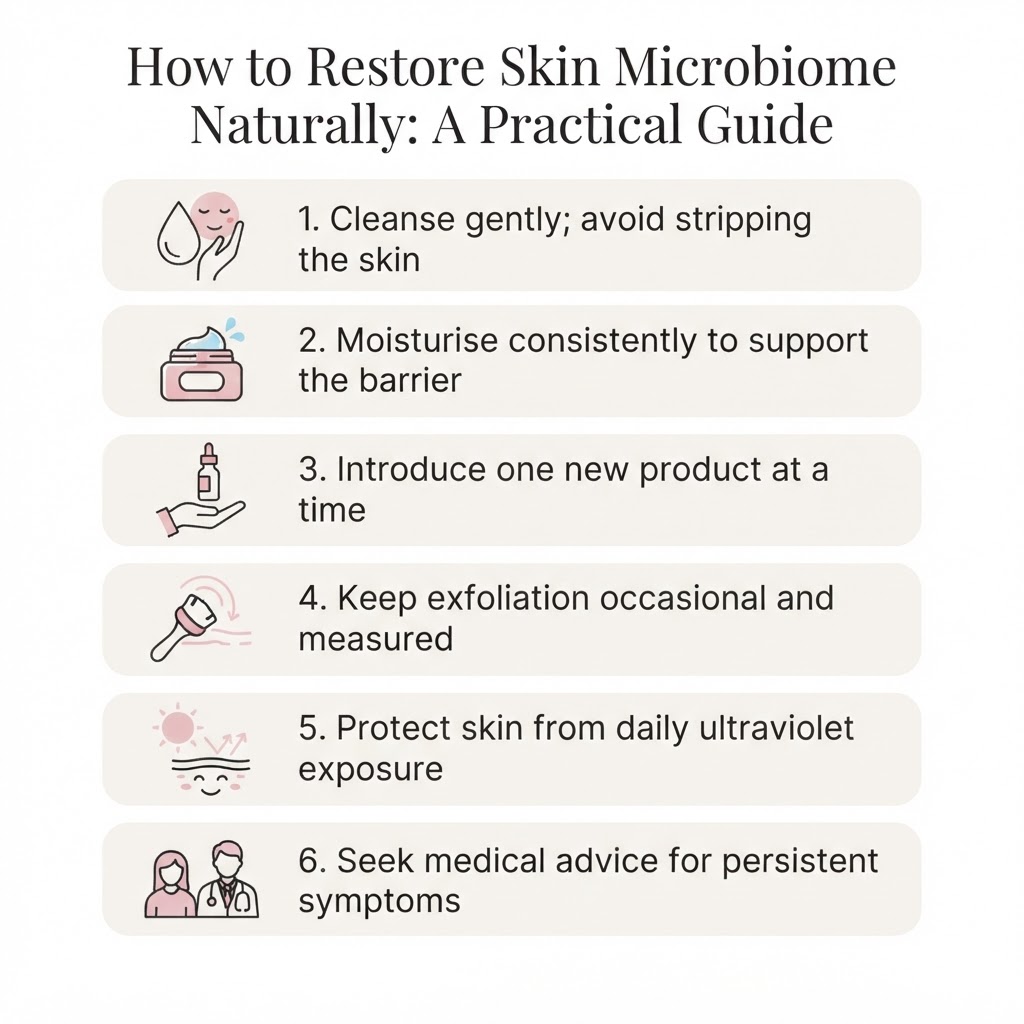
So when people ask how to restore skin microbiome naturally, the most evidence-aligned first move is often to support the environment rather than attempt to repopulate it. Gentle cleansing, suitable moisturising, sensible sun protection, and avoiding repeated irritation are practical ways to do that. These steps are modest, but they address conditions the skin depends on every day.
“The skin microbiome is shaped by the environment and the characteristics of each body site, rather than by a universal one-size-fits-all profile.”
— Grice and Segre, Nature Reviews Microbiology, 2011
For a clear foundation in the terminology, read What Is the Skin Microbiome Explained Simply?. If you are trying to understand changes you have noticed, our guide to signs your skin microbiome may be out of balance offers further context without treating any one symptom as proof of a microbial problem.
How daily habits can support—or disrupt—the balance
Many routine problems come from cumulative friction: an over-strong cleanser, frequent exfoliation, several new active ingredients, and washing whenever the face feels oily. Each choice may seem reasonable alone, yet repeated exposure can leave less room for the barrier to recover. A simplified routine helps you notice which products your skin actually tolerates.
Cleanse without trying to make skin “squeaky clean”
Choose a mild cleanser that removes sunscreen, makeup, sweat, and excess oil without leaving a persistent tight or burning feeling. Use lukewarm rather than hot water, and keep rubbing brief. Some people with dry or sensitive skin prefer a water rinse in the morning and a cleanser in the evening; oily or sunscreen-wearing skin may prefer cleansing at both times. Let comfort, not a rigid rule, guide frequency.
Strong surfactants, abrasive brushes, and repeated cleansing can remove surface lipids and aggravate dryness. That does not mean cleansing is harmful in itself: removing accumulated sunscreen, pollution, and makeup can be useful. The aim is enough cleansing for your day, not the most powerful cleanse possible.
Moisturise to support the barrier
A moisturiser can reduce water loss and improve comfort by combining ingredients that attract water, soften the surface, or help form a protective layer. Glycerin is a familiar humectant; ceramides and other lipids can contribute to a barrier-supportive formula. Texture matters, too: a rich cream may suit dry skin, while a lighter lotion or gel-cream may be more comfortable for oily areas.
Apply moisturiser after washing while skin is still slightly damp if that feels comfortable. If a product reliably stings, makes redness worse, or triggers persistent bumps, stop and reassess rather than pushing through. Fragrance, preservatives, and active ingredients are not automatically unsuitable, but individual tolerance varies.
Use sun protection as part of a steady routine
Broad-spectrum sunscreen helps limit ultraviolet exposure, which contributes to visible photoageing and can deepen the appearance of post-inflammatory dark marks. Select a formula you are willing to apply consistently and follow its label directions. A hat, shade, and protective clothing add useful layers, especially during prolonged outdoor activity.
For deeper complexions, visible light may also contribute to persistent pigmentation in some circumstances. Tinted sunscreens containing iron oxides can offer visible-light protection, though shade match and personal comfort affect whether someone will use one regularly. Sun protection is not a promise that every mark will fade; it is one part of limiting ongoing exposure.
- Keep the core routine small: cleanse, moisturise, and use daytime sun protection.
- Wash makeup tools and pillowcases regularly, without turning hygiene into aggressive skin scrubbing.
- Avoid picking at blemishes, which can prolong irritation and increase the chance of lingering marks.
- Introduce one new product at a time so you can observe tolerance.
A review of how skin microbes interact with skin function is available in the peer-reviewed journal Nature Reviews Microbiology. It helps explain why a practical routine should consider the skin’s environment rather than assume that more cleansing or more microbes necessarily means better outcomes.
A realistic routine: calm first, then add targeted care
A useful way to approach how to restore skin microbiome naturally is to separate foundational care from targeted treatments. First establish a routine your skin can tolerate. Then, if a specific concern remains, consider adding one targeted product at a time. A serum can deliver a focused formula, but it is not automatically more important than a cleanser or moisturiser that keeps the routine comfortable.
Morning
Rinse with water or cleanse gently, depending on your skin’s needs.
Apply a moisturiser if your skin feels dry or tight.
Finish with a broad-spectrum sunscreen that suits your skin tone and daily routine.
Evening
Remove sunscreen and makeup with a gentle cleanser. If you use long-wear products, a first-step remover followed by a mild cleanser may be helpful, provided the combination does not leave skin uncomfortable.
Apply a serum only if you have a clear reason to use it and it fits comfortably into the routine. Follow the product directions; more layers do not automatically produce better results.
Apply moisturiser to reduce dryness and support the barrier overnight.
Probiotic skincare is one category people encounter when looking for microbiome-friendly formulas. Products marketed this way may contain live microorganisms, non-living microbial materials, or ingredients intended to support a favourable skin environment; these are not interchangeable. Formulation quality, stability, and the evidence for a particular product matter. The label alone cannot establish that a product will change the microbiome or improve a skin condition.
Velobiotics™ is Almasi’s approach to probiotic-inspired skincare formulation. If you want to explore it, look at the ingredient list and usage directions for an Almasi probiotic serum, patch test if appropriate, and introduce it as a single change. A serum should complement, not replace, the basic steps that keep skin comfortable.
For background on what this product category can and cannot tell you, see our article What Is Probiotic Skincare and Does It Work?. Research on topical probiotics is developing, and results from laboratory studies or small studies cannot automatically be applied to every product or every person.
“A healthy skin barrier is essential for maintaining skin hydration and limiting the penetration of irritants.”
— American Academy of Dermatology Association, Skin barrier guidance
As a practical rule, give a stable basic routine several weeks before judging comfort, unless you develop a reaction that warrants stopping sooner. Skin renewal is gradual, and visible changes in pigmentation or texture may take longer than changes in dryness. Avoid treating a short-term flare as evidence that your microbiome is permanently damaged.
Adapting microbiome-friendly care to common concerns
Adult acne-prone skin
Adult acne can involve clogged pores, inflammation, hormones, genetics, and other factors. It is not proof that skin is dirty or that its microbiome simply needs “more good bacteria.” Over-washing and harsh scrubs can irritate the surface without addressing the processes behind acne. A gentle cleanser and non-comedogenic moisturiser can help keep a routine tolerable while you seek suitable acne guidance.
Evidence-based acne ingredients may be useful for some people, but they can also cause dryness or irritation. Start only one active at a time, follow its directions, and consult a clinician if breakouts are persistent, painful, or leaving scars or dark marks. If an active makes skin increasingly sore or inflamed, pause it and ask a qualified professional what to do next.
Eczema-prone or highly sensitive skin
Eczema is a medical condition involving an impaired barrier and inflammation; it is not simply a microbiome imbalance that can be corrected with cosmetics. During a flare, a fragrance-free, simple moisturiser may be easier to tolerate, but individual needs vary. New products can provoke reactions even when they are marketed as gentle or microbiome-friendly.
People with recurring itch, cracked skin, sleep disruption, oozing, or worsening symptoms should seek medical advice. A dermatologist or other qualified clinician can help identify triggers and recommend appropriate care. For more on routine considerations, read our guide to moisturising eczema-prone skin, while remembering that a cosmetic moisturiser is not a substitute for prescribed care.
Hyperpigmentation and melanin-rich skin
Post-inflammatory hyperpigmentation is a dark mark that can remain after inflammation, such as a pimple, has settled. It can affect any skin tone and may be especially noticeable or persistent in melanin-rich skin. Avoiding unnecessary irritation is important because inflammation itself can contribute to further discoloration. Gentle handling and consistent sun protection are more sensible foundations than aggressive exfoliation.
Do not assume that a stronger acid or more frequent scrub will speed progress. If you are considering ingredients for uneven tone, introduce them cautiously and consider advice from a dermatologist familiar with your skin tone and history. Our practical guide to skincare for melanin-rich skin discusses routine choices, and this guide to vitamin C serum for dark spots explains how to approach one commonly used antioxidant ingredient.
Ageing skin
With age, skin can become drier or more sensitive, although the pace and pattern differ widely. A routine that once felt comfortable may need a gentler cleanser or a richer moisturiser over time. Sun protection remains a practical daily habit, while any retinoid or exfoliating product should be introduced thoughtfully, especially if the skin is already dry or reactive.
The goal is not to preserve a youthful microbiome or chase an ideal age-related skin profile. It is to keep skin comfortable and protect its barrier while addressing personal priorities. Adjust textures and frequency as needed rather than assuming every mature complexion requires the same routine.
What to avoid, when to seek help, and how to judge progress
Some popular “natural” approaches can be irritating or unreliable. Natural does not automatically mean gentle, safe, or suitable for the face. Essential oils and fragranced botanical extracts can trigger sensitivity in some people, while lemon juice, baking soda, and undiluted vinegar can disrupt comfort and irritate skin.
- Do not attempt to sterilise the skin or remove all oil; the skin surface is meant to host a microbial community.
- Do not layer multiple exfoliants, strong retinoids, and acne actives simply because each has a different marketing claim.
- Do not apply food, homemade ferments, or non-skin products to broken or irritated skin.
- Do not keep using a product that causes swelling, burning, a spreading rash, or escalating discomfort.
When evaluating whether how to restore skin microbiome naturally is working for you, track practical outcomes rather than trying to infer which microbes are present. Once a week, note whether your skin feels less tight after washing, whether moisturiser is comfortable, and whether irritation is becoming more frequent. Take photographs in similar lighting if you are monitoring marks or texture; day-to-day visual impressions can be misleading.
Change one thing at a time and give a new routine a fair trial, unless a reaction appears. A patch test may help identify some forms of irritation, though it cannot rule out every allergy or delayed reaction. Follow product directions and seek medical advice for persistent symptoms, severe discomfort, suspected infection, or acne and eczema that are affecting quality of life.
Research is still clarifying how topical products influence the skin microbiome in real-world use. A peer-reviewed overview of the skin microbiome and health is available through the Journal of Clinical Investigation. For practical guidance on gentle skin care and common concerns, consult the American Academy of Dermatology Association’s skin-care guidance.
Start with one simple step
The simplest first step is to make your next cleanse gentler: use lukewarm water and a mild cleanser, then apply a moisturiser that leaves your skin comfortable. Keep that change steady before adding another product. If you would like to explore Almasi’s routine options, browse the Almasi skincare collection and choose a product that fits your needs and preferences.
Subscribe to the Almasi Journal for thoughtful skincare guidance, ingredient explainers, and new articles from our team.