
“Probiotic skincare” appears on serum bottles, moisturisers and product pages, often alongside claims about balance, calm and barrier support. But the phrase can mean different things, and it does not automatically tell you what is inside a formula or what it can realistically do for your skin.
If you are asking what is probiotic skincare and does it work, the useful answer starts with the skin microbiome: the community of microorganisms that lives on the skin and interacts with its environment. Some topical formulas are designed to support a skin-friendly environment using probiotic-derived ingredients, such as ferments or lysates. Early research is interesting, but products and evidence vary, so results should be approached thoughtfully.
I’m Dr. Chomba Chuma, MD and founder of Almasi. In this guide, I’ll explain the terms, what the research can and cannot tell us, and how to assess a routine for adult acne-prone, eczema-prone, ageing or melanin-rich skin—without expecting one serum to solve every concern.
First, what does “probiotic skincare” mean?
A probiotic is generally defined as a live microorganism that, when administered in adequate amounts, confers a health benefit on the host. That definition was developed mainly for foods and supplements. It does not map neatly onto every topical cosmetic, especially because many skincare formulas contain non-living ingredients derived from microorganisms rather than live cultures.
On a skincare label, “probiotic” may be used broadly. It can refer to ingredients produced through fermentation, components from microorganisms, or—in some cases—live microbes. These are not interchangeable. A product’s ingredient list and the manufacturer’s explanation matter more than the label alone.
- Ferments: materials created or changed through fermentation. Their composition depends on the source organism and manufacturing process.
- Lysates: ingredients made from broken-down microbial cells. They are not live bacteria, but may contain cell components that interact with the skin.
- Prebiotics: ingredients intended to provide a resource that may support certain microorganisms. In skincare, this term is used in different ways and does not guarantee a specific microbiome outcome.
- Live probiotics: living microorganisms. Keeping them viable, safe and stable in a cosmetic product can be technically challenging.
So, when someone asks what is probiotic skincare and does it work, a more precise follow-up is: which type of ingredient is in the product, what is it formulated to do, and what evidence supports that use? The word “probiotic” alone cannot answer those questions.
Your skin microbiome: a living ecosystem
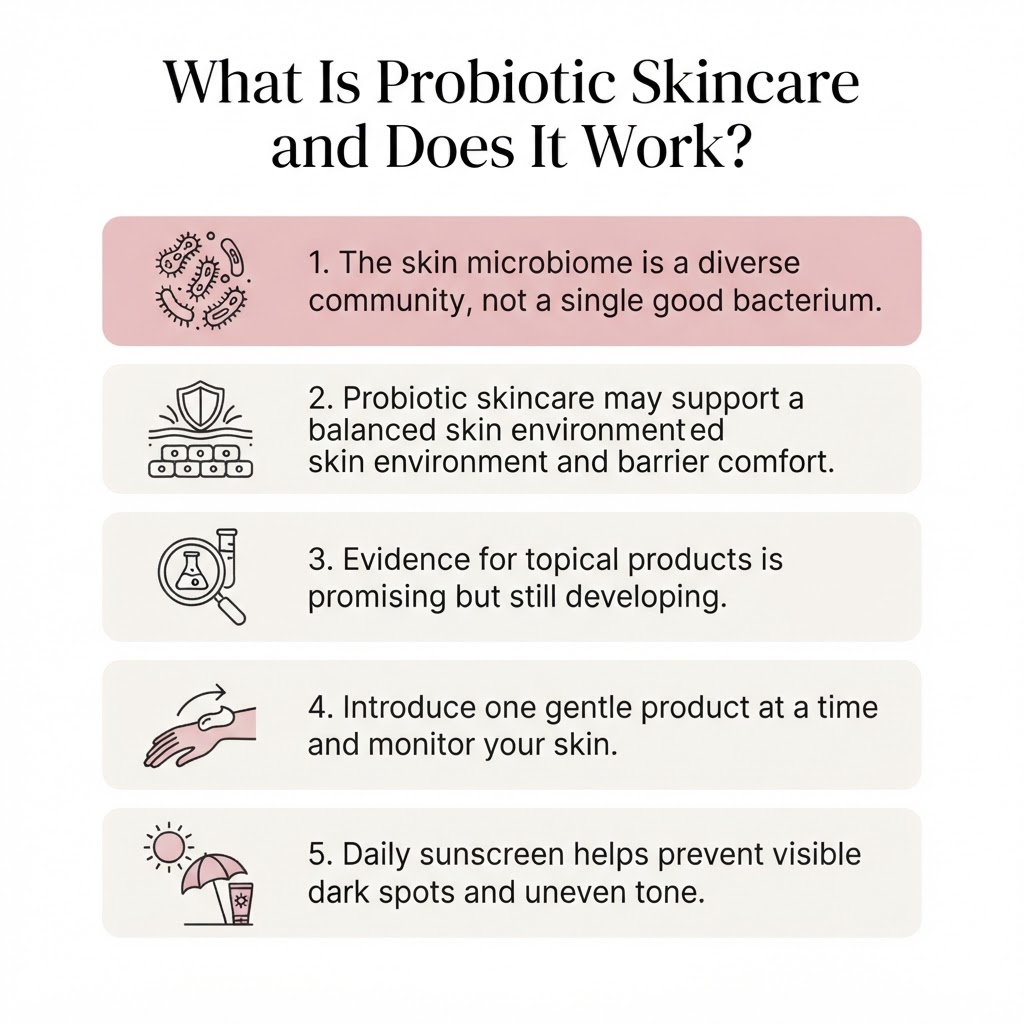
The skin microbiome is the collection of microorganisms—including bacteria, fungi and viruses—that live on the skin. It is an ecosystem, not a layer of dirt that should be scrubbed away. Microbial communities vary between people and across body sites because skin differs in moisture, oiliness, temperature and exposure.
Microbes interact with one another and with the skin’s immune system. They can compete for space and nutrients, produce substances, and influence how the skin responds to its surroundings. The skin barrier—the outer protective layer—also shapes which organisms thrive. A balanced relationship matters more than having one “good” species dominate every face.
Research on the microbiome is advancing, but scientists are still working out which microbial patterns are causes, consequences or simply companions of particular skin conditions. A finding in a laboratory or a small study does not establish that a cosmetic product will produce the same effect in daily life.
“The skin microbiome is a complex ecosystem whose composition and function vary across body sites and individuals.”
— Byrd, Belkaid and Segre, Nature Reviews Microbiology, 2018
The review The human skin microbiome describes how skin microbes and host biology interact. It is a useful foundation for understanding why the goal is not to sterilise skin, but to care for it in a way that respects its barrier and changing environment.
Over-cleansing, frequent exfoliation, harsh products and some environmental exposures can leave skin feeling dry or reactive. That does not mean every irritation is a microbiome problem; it does mean that a gentle routine is often a sensible starting point.
What research suggests—and what it cannot promise
Topical microbiome-focused skincare is a developing area. Laboratory studies and early clinical research suggest that some microbial-derived ingredients may influence skin comfort, hydration, barrier-related measures or visible redness. However, study size, ingredient choice, product formulation and outcome measures differ. A result for one ingredient cannot be assumed for every product called “probiotic.”
When evaluating what is probiotic skincare and does it work, separate three questions: is there a plausible biological mechanism, has the specific ingredient been studied on people, and has the finished product been tested for the concern you care about? The strongest answers come from product-specific evidence, not from a general claim about probiotics.
For example, an ingredient might show activity in a laboratory dish, but that does not tell us whether it remains stable in a jar, reaches the relevant part of the skin, or makes a noticeable difference under normal use. A study may also include a small group or a short follow-up period, making it difficult to generalise results.
“The skin microbiome is a rapidly evolving field, and much remains to be learned about how microbial communities contribute to skin health and disease.”
— National Academies of Sciences, Engineering, and Medicine, 2020
The National Academies’ report, The Human Microbiome, Skin Health, and Disease, reviews the field’s opportunities and research gaps. Its central lesson for shoppers is useful: promising science is not the same as a guaranteed individual result.
In practical terms, a well-formulated microbiome-focused serum or moisturiser may fit into a routine that supports hydration and skin comfort. It should not be presented as a replacement for prescribed care, sunscreen, or ingredients with stronger evidence for a specific concern. The finished formula matters: fragrance, preservatives, texture and compatibility with your skin can all affect how it feels and performs.
How it may fit different skin concerns
Adult acne-prone skin
Adult acne can involve clogged pores, inflammation, hormones, genetics and other factors. It is not simply a sign that the skin is “dirty” or that its microbiome is unbalanced. A probiotic-derived ingredient cannot be assumed to clear acne, and a microbiome-friendly label is not a substitute for acne care supported by a dermatologist.
If your skin is blemish-prone, look for a routine that is gentle, consistent and suited to your needs. Avoid piling several new actives onto a reactive face. A light moisturiser can support comfort without forcing you to choose between hydration and a non-greasy feel. If breakouts are persistent, painful or leaving marks, ask a qualified clinician about options rather than waiting for a cosmetic product to do more than it is designed to do.
Eczema-prone or easily irritated skin
Eczema-prone skin can be dry, itchy and sensitive, with periods of flare and calm. A topical probiotic product should not be described as a treatment for eczema. If you have eczema, follow your clinician’s care plan and patch-test unfamiliar products; avoid applying a new cosmetic to broken or actively irritated skin unless your clinician advises otherwise.
For a closer look at choosing a moisturiser with this concern in mind, read Probiotic Moisturiser for Eczema-Prone Skin: Barrier Guide. The most helpful routine is often uncomplicated: gentle cleansing when needed, a moisturiser you tolerate, and guidance from a clinician when symptoms are difficult to manage.
Hyperpigmentation and melanin-rich skin
Post-inflammatory hyperpigmentation is darkening that can remain after inflammation, such as a blemish or irritation, has settled. It can occur in every skin tone and may be more noticeable or persistent in some people with melanin-rich skin. Preventing avoidable irritation is important: repeated stinging and over-exfoliation can create new inflammation that leaves additional marks.
Probiotic skincare is not a pigment-erasing shortcut. Consider it, at most, one possible part of a comfortable routine. Daily broad-spectrum sunscreen is important for limiting further UV-related darkening, while a dermatologist can help you choose evidence-based options for stubborn or changing pigmentation. For deeper context on pairing antioxidant care with a sensible routine, see Almasi Vitamin C Serum Reviews: A Smarter Skin Guide.
Ageing and changing skin
With age, skin may become drier, feel less resilient or respond differently to products. Sun exposure and genetics also influence visible changes. A probiotic-derived serum may be appealing if its formula supports hydration and comfort, but it should not be expected to reverse ageing or replace sun protection and other suitable skincare.
Across all these concerns, the practical question is whether the product feels comfortable, fits your routine and has a clear, realistic purpose. People with all skin tones deserve that same careful standard of evidence and thoughtful formulation.
Choosing a serum or moisturiser and building a routine
Serums and moisturisers serve different routine roles. A serum is often a lighter, concentrated step chosen for a particular texture or ingredient profile. A moisturiser is generally designed to add and help retain hydration. The names alone do not establish which product is right; check the full formula and how your skin responds.
If you are still weighing what is probiotic skincare and does it work for your own face, start by defining a modest goal: perhaps less tightness after cleansing, a more comfortable feel, or a simpler routine you can maintain. Do not use a cosmetic label to self-diagnose a skin condition.
- Morning: use a gentle cleanser if needed, apply a serum or moisturiser you already tolerate, and finish with broad-spectrum sunscreen.
- Evening: remove sunscreen and makeup gently, then apply your chosen moisturiser. Add a new serum only if it serves a clear purpose.
- Introduce slowly: try one new product at a time and follow its directions. Patch-test if you are prone to reactions.
- Give it a fair trial: keep the rest of your routine stable and note comfort, dryness, stinging or new blemishes.
- Pause if needed: stop using a product that causes persistent irritation, swelling or discomfort, and seek medical advice for a significant reaction.
For product selection, review the ingredient list, packaging and directions. Ask whether the formula is fragrance-free if fragrance commonly bothers you, whether its texture suits your skin, and whether the brand explains what “probiotic” means in that specific product. Claims should describe cosmetic support, not promise a medical outcome.
Almasi’s Almasi probiotic serum and moisturiser options are designed around Velobiotics™ technology. Explore the product information and full ingredients, then choose only what makes sense for your routine and sensitivities. No product is right for everyone, and you do not need a multi-step routine to begin.
How to judge claims and set realistic expectations
Commercial skincare language can make a complex scientific field sound simple. Before buying, look beyond words such as “balance,” “microbiome-friendly” or “probiotic.” A useful product page should explain the ingredient approach, give clear directions and avoid suggesting that a cosmetic can diagnose or manage a medical condition.
Research is easiest to interpret when you check whether it studied the finished product, the same ingredient and concentration, and people with a concern similar to yours. A study on a different ferment, a laboratory model or a small group can help generate a hypothesis, but it does not settle whether your chosen bottle will make a visible difference.
It also helps to keep expectations measurable. Instead of asking whether a product “fixed” your skin, consider whether it is comfortable to use, whether dryness feels better, whether it fits alongside sunscreen and any clinician-recommended care, and whether your skin remains settled over time. If your concern is worsening or affecting your quality of life, a dermatologist can help identify suitable next steps.
In short, the clearest answer to what is probiotic skincare and does it work is nuanced: it is a broad category of topical products using microbial or fermentation-related ingredients, and some formulations may support skin comfort or barrier-friendly routines. The field is promising, but evidence is not uniform, and outcomes depend on the exact formula and person using it.
Your simplest first step: choose one gentle product
Start with one product you can use consistently, rather than replacing your whole routine. If you would like to explore the range, take a look at Almasi’s probiotic skincare collection, read each product’s ingredient information, and choose the serum or moisturiser that best fits your skin and preferences.
Subscribe to the Almasi Journal for thoughtful skincare guidance, ingredient explainers and practical routine ideas.