
Dark spots can linger long after the blemish, irritation or sun exposure that first made them visible. If you are comparing a vitamin c serum for dark spots, it helps to look beyond a high percentage on the label. The right product is one you can use consistently, without leaving your skin tight, stinging or inflamed.
I’m Dr. Chomba Chuma, MD and founder of Almasi. In practice, I encourage people to think of uneven-looking tone as a gradual skin concern, not a flaw to scrub away. A thoughtful routine pairs an appropriate brightening ingredient with daily sun protection and care for the skin barrier—the outer layer that helps keep water in and irritants out.
This guide explains how vitamin C fits into that routine, what to consider for acne-prone adult skin and eczema-prone skin, and why a microbiome-conscious approach can be useful. It also covers realistic timelines, product selection and the signs that mean it is time to simplify rather than add another active.
What dark spots are—and why they can be persistent
Hyperpigmentation is a broad term for areas of skin that appear darker than the surrounding skin. It is associated with increased melanin, the pigment that gives skin its colour. Melanin is made by specialised cells called melanocytes, and its production can rise in response to ultraviolet (UV) light, inflammation or hormonal signals.
That is why marks may follow acne, a rash, friction or an irritating product. Post-inflammatory hyperpigmentation (PIH) is the name for darker marks that develop after inflammation. Melasma, by contrast, often appears as larger, more symmetrical patches and can be influenced by hormones and light exposure. These patterns can overlap, so persistent or changing patches deserve an individual assessment.
- After acne: a flat brown or grey-brown mark can remain after a spot has settled; it is different from a raised or indented acne scar.
- After irritation: rubbing, over-exfoliation or a reaction to a product may leave a visible mark, particularly when the skin is prone to pigment changes.
- With sun exposure: UV light can deepen existing marks and encourage new uneven areas, even when the weather feels cool or cloudy.
- With hormonal influence: melasma can be persistent and may require clinician-guided care alongside careful sun protection.
In melanin-rich skin, pigment-producing cells are active across all skin tones, but inflammation can make the resulting contrast more noticeable and long-lasting. This does not mean that every person with deeper skin needs a stronger product. Often, avoiding irritation is as important as selecting an ingredient with a plausible brightening role.
For a deeper look at tailoring care to different skin tones, see our practical routine guide for melanin-rich skin. The key principle is the same: avoid turning a mild concern into a barrier problem by chasing rapid results.
How vitamin C may support a more even-looking complexion
Vitamin C, also called ascorbic acid in its best-known form, is an antioxidant. Antioxidants help counter oxidative stress: chemical activity caused in part by UV exposure and pollution that can affect skin cells. Topical vitamin C has been studied for its role in photoprotection support and the appearance of uneven tone, but it is not a substitute for sunscreen.
Melanin production involves several biological steps. Laboratory and clinical research suggests vitamin C can interact with processes involved in pigment formation, while its antioxidant properties may help limit some effects of environmental stress. These findings support a reasonable role for vitamin C in a broader routine; they do not mean every formula will work equally well for every person.
“Topical vitamin C has been shown to have a wide range of clinical applications, including photoaging, hyperpigmentation, and tissue inflammation.”
— Pullar, Carr and Vissers, Nutrients, 2017
The form matters. L-ascorbic acid is well studied, but it can be unstable in water-based formulas and may feel uncomfortable for sensitive skin, particularly at higher concentrations or in a low-pH product. Other vitamin C derivatives are designed to improve stability or tolerability; evidence varies by derivative and finished formula. A percentage alone cannot tell you how a serum will perform.
When you assess a vitamin c serum for dark spots, consider the whole product and the routine it has to fit into. A formula that feels comfortable and is used regularly is often a more practical choice than a very potent serum that is repeatedly abandoned because it stings.
- Check the ingredient list for the vitamin C form and follow the product’s storage instructions.
- Choose packaging that limits unnecessary exposure to air and light when the formula is sensitive to them.
- Do not assume a higher concentration is automatically more effective or suitable for your skin.
- Look for clear directions and avoid combining several newly introduced actives at once.
For a review of how antioxidant care can sit alongside sun protection, read our article on vitamin C and antioxidant support. The useful distinction is that a serum is one part of care; it does not create an invisible shield that replaces other protective habits.
Build the routine around tolerance, not intensity
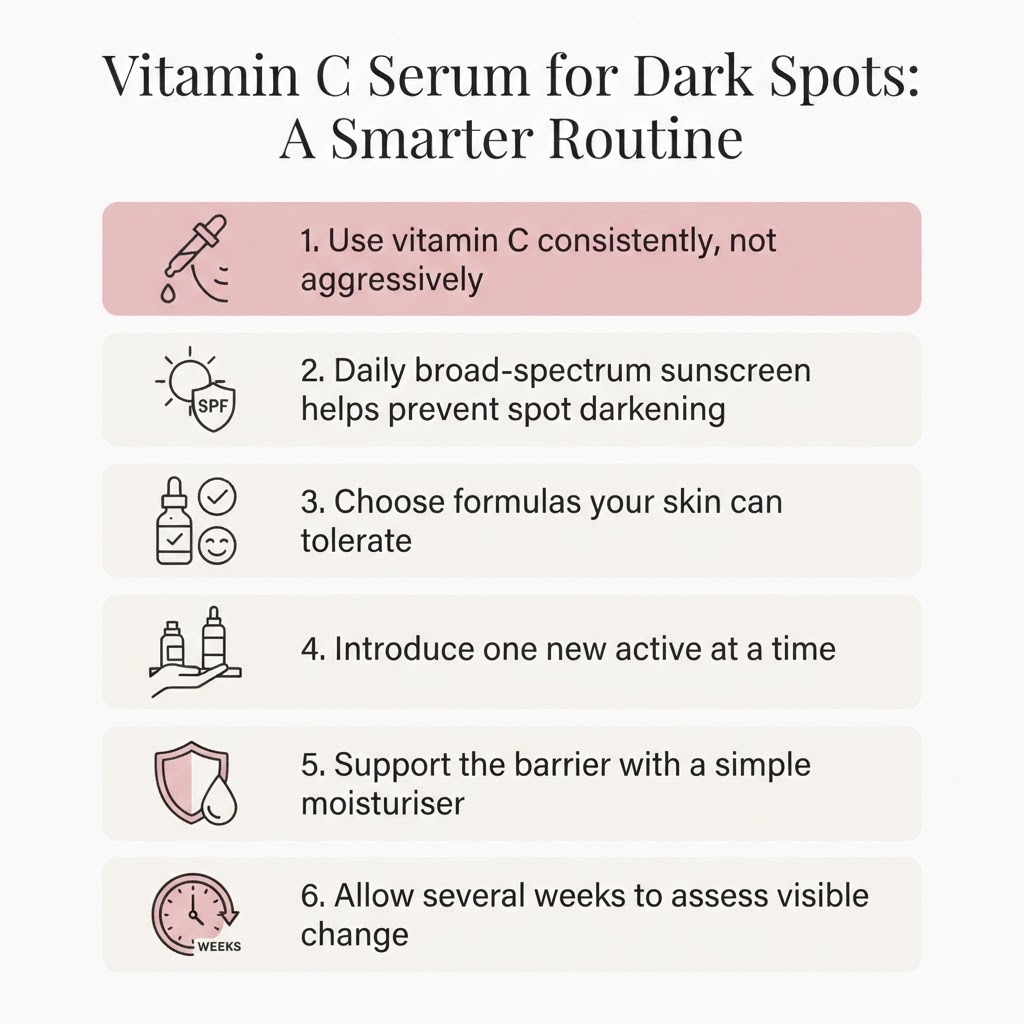
A brightening routine works best when its basics are steady. Cleanse without stripping, apply one suitable active, moisturise if needed and use broad-spectrum sunscreen during the day. Broad-spectrum means the sunscreen is designed to protect against both UVA and UVB rays. Follow the label directions and reapply as directed, especially with prolonged outdoor exposure.
A simple morning sequence
- Cleanse gently. In the morning, some people prefer a rinse; others benefit from a mild cleanser. Choose based on oiliness, sweat and comfort rather than a rule that everyone must cleanse twice daily.
- Apply vitamin C to dry skin. Use the amount directed on the product label. If you are sensitive, begin less often than daily and increase only if your skin remains comfortable.
- Moisturise where needed. A moisturiser can reduce the feeling of dryness and help the routine feel more manageable. Acne-prone skin can still benefit from a light, non-comedogenic texture.
- Finish with sunscreen. Use a broad-spectrum sunscreen with SPF 30 or higher, applying an adequate amount and reapplying according to its instructions.
The American Academy of Dermatology recommends broad-spectrum, water-resistant sunscreen with SPF 30 or higher. For people managing visible pigmentation, sunscreen is not a side note: UV exposure can undermine progress and darken marks. If visible light seems to aggravate your melasma or pigmentation, ask a dermatologist whether a tinted sunscreen containing iron oxides may be appropriate for you.
“Use a broad-spectrum sunscreen with an SPF of 30 or higher.”
— American Academy of Dermatology, Sunscreen FAQs
Choosing a serum for acne-prone, sensitive or eczema-prone skin
Skin type can shift over time, and the same person may experience oiliness, dehydration and sensitivity at once. Adult acne can occur alongside pigment marks, while eczema-prone skin may react to fragrance, harsh cleansing or an active ingredient that is otherwise tolerated by a friend. The aim is not to label your skin permanently; it is to notice how it responds.
If you are acne-prone
Flat marks after a breakout are not a reason to attack the skin with multiple exfoliants. Overuse of acids, scrubs and strong retinoids can add irritation, which may contribute to more visible post-inflammatory marks. Keep your acne plan and brightening plan coordinated, especially if a clinician has prescribed medication.
- Introduce vitamin C on a night or morning when you are not also testing another new active.
- If you use benzoyl peroxide, retinoids or exfoliating acids, ask a pharmacist or clinician how to space products safely.
- Do not pick or squeeze spots; mechanical trauma can prolong inflammation and leave more noticeable marks.
- Choose a moisturiser that feels comfortable rather than skipping moisturiser because your skin is oily.
If you are eczema-prone or easily irritated
When skin is actively inflamed, cracked or intensely itchy, pause non-essential brightening products on that area. A serum that tingles is not necessarily working; persistent burning, swelling or worsening redness is a reason to rinse it off and stop use. If eczema symptoms are frequent or severe, follow the advice of your healthcare professional rather than relying on cosmetic products.
Patch testing can help identify obvious intolerance, although it cannot guarantee that a product will never cause a reaction. Apply a small amount to a discreet area as directed over several days, and do not test on broken or actively inflamed skin. For broader context on gentle routines, explore our guide to supporting the skin barrier.
Barrier support is relevant because a compromised outer layer can increase water loss and sensitivity. A gentle cleanser, a moisturiser suited to your skin and a measured approach to actives create a more forgiving routine. A product cannot repair every cause of sensitivity, but a simpler routine makes it easier to spot what your skin tolerates.
Where probiotic skincare and the skin microbiome fit
The skin microbiome is the community of microorganisms that live on the skin’s surface, including bacteria and fungi. It exists alongside the barrier and is influenced by the skin’s environment, personal care habits and other factors. Microbiome-conscious skincare aims to respect this ecosystem rather than treating all microbes as unwanted.
Probiotic skincare is a broad marketing and formulation category, and products can differ substantially. Some include ingredients derived from fermentation or microbial processes; others may use particular lysates or filtrates. These ingredients are not the same as taking a live probiotic supplement, and it is important to evaluate the actual formula rather than assume a universal effect.
In a routine for uneven-looking tone, microbiome-conscious care is best understood as supportive, not as a direct replacement for sunscreen or a targeted active. If a cleanser leaves skin squeaky or a serum repeatedly causes irritation, revisiting those choices may be more helpful than adding further steps. Learn more about this wider context in our simple explanation of the skin microbiome.
At Almasi, our Velobiotics™ approach informs how we think about probiotic skincare and routines that respect the skin’s surface environment. If you are interested in exploring the range, you can view Almasi probiotic serum and other products. Choose based on your needs, ingredient preferences and tolerance—not on the assumption that any one product is necessary for everyone.
How to introduce vitamin C and judge progress
Visible changes take time, and different causes of pigmentation behave differently. A small mark after a spot may fade gradually; melasma can be more persistent and may fluctuate with sun exposure or hormonal factors. It is reasonable to give a consistent, tolerated routine several weeks before judging its cosmetic effect, while continuing sun protection throughout.
A cautious four-week introduction
- Week 1: keep the routine familiar and patch test the new serum according to its instructions.
- Week 2: use it once or twice, if the patch test is comfortable. Avoid adding other new active products.
- Week 3: continue at the same frequency or increase modestly if your skin remains calm and the label allows it.
- Week 4: review comfort, dryness and consistency. Increase use only when there is a good reason and no signs of irritation.
Take a baseline photograph in consistent lighting if tracking change would help you. Do not compare images taken in different lighting or with different camera settings; these can exaggerate or hide tonal differences. If the skin becomes sore, persistently red, flaky or more pigmented, step back and consider professional advice.
A vitamin c serum for dark spots should not be expected to erase marks overnight. It is one possible component of a routine, and the results depend on the cause of pigmentation, the formula, regular use and protection from exposure that can deepen it. The goal is a steady, comfortable plan rather than a sequence of harsh experiments.
When to seek individual advice
Not every dark mark is simply post-acne pigmentation. A dermatologist or other qualified healthcare professional can help distinguish common pigment patterns, review medicines and discuss appropriate options. Seek assessment for a spot that is changing in size, shape or colour, bleeding, painful, or otherwise unusual; do not treat a potentially concerning lesion as a cosmetic mark.
Professional guidance is especially useful if patches are widespread, recur despite careful habits, affect confidence significantly or do not respond to a patient routine. A clinician can also consider whether an underlying rash, hormonal factor or medication is contributing. In some cases, prescription treatments or in-office procedures may be discussed, but suitability depends on diagnosis, skin tone, medical history and the risk of irritation.
Research on topical vitamin C continues to develop. One useful review is the review of vitamin C and its role in skin health in Nutrients. For practical sun-protection advice, see the American Academy of Dermatology’s sunscreen guidance. These resources provide general information, not a personalised diagnosis or treatment plan.
If you are weighing a vitamin c serum for dark spots against another active, remember that a simpler routine can be the more effective routine for real life. Use products as directed, give your skin time to respond and make comfort a meaningful measure of success. For an overview of choosing a serum, see our Almasi vitamin C serum guide.
Your simplest first step: make sunscreen consistent
Before adding another active, choose a broad-spectrum SPF 30 or higher that you are willing to apply every day and use as directed. Once that habit feels settled, consider introducing one suitable vitamin C product gradually; explore Almasi skincare if you would like to see the range.
Subscribe to the Almasi Journal for thoughtful, science-informed guidance on skin, routines and ingredients.