
Your skin can feel unexpectedly tight after cleansing, break out in unfamiliar places, or react to products you have used for months. These changes are frustrating, but they do not automatically mean that something is wrong with your skin’s microbiome. They are clues to look at your routine, environment and skin barrier together.
The phrase signs your skin microbiome is out of balance is useful as a starting point for observation, not as a diagnosis. Redness, flaking, blemishes and sensitivity can have many causes, from dry air and over-exfoliation to acne, eczema, rosacea or an allergy. Similar-looking symptoms may need different care.
I’m Dr. Chomba Chuma, MD, founder of Almasi. In this guide, I’ll explain what a microbiome-related change might look like, what it cannot tell you, and how to build a measured routine that respects diverse skin tones, including melanin-rich skin. The aim is not to sterilise the skin or chase a perfect complexion; it is to support comfort and a resilient barrier.
What the skin microbiome can—and cannot—tell you
The skin microbiome is the community of microorganisms that live on the skin’s surface. It includes bacteria, fungi and viruses, most of which coexist with us without causing disease. The mix varies across body sites and changes with factors such as age, climate, sebum, moisture, hormones and personal care habits.
Microbes are not simply “good” or “bad.” Their effects depend on the organism, its location and the surrounding skin environment. A diverse community can be part of healthy skin, but a larger number of microbial species does not, by itself, prove that skin is healthier. Researchers continue to investigate how microbes interact with the skin’s immune system and barrier.
The barrier is the outer protective layer of skin. It limits excessive water loss and helps shield the body from irritants and environmental exposure. When it is disrupted, the skin may become dry, sting more easily or look inflamed. Microbial shifts and barrier changes may influence one another, but an everyday symptom cannot reveal which came first.
For a clear introduction to the terminology, see our guide to what the skin microbiome is. For broader research context, the review The skin microbiome in Nature Reviews Microbiology describes the skin as a distinct microbial habitat and discusses its relationship with health.
So, what might prompt a closer look? The following are possible signals of a change in skin comfort or function—not proof of a microbial imbalance.
Signs to notice—and why they are not a diagnosis
New or persistent sensitivity
If a familiar moisturiser suddenly stings, or several products cause burning, the barrier may be irritated. That can happen after frequent exfoliation, a strong retinoid, harsh cleansing, cold weather or a reaction to an ingredient. A changed microbiome is one possible part of a wider picture, but sensitivity alone cannot identify it.
Recurring dryness, tightness or rough patches
Skin that feels tight soon after washing may be losing too much water or encountering a cleanser that is too stripping. Flaking and roughness can also come from low humidity, eczema-prone skin or a change in medication. If the pattern continues despite gentler care, ask a health professional rather than repeatedly adding products.
Breakouts alongside irritation
Adult acne can appear as blackheads, whiteheads, inflamed spots or deeper tender lesions. It is influenced by several factors, including hormones, oil production, follicular plugging and inflammation. Breakouts do not mean the skin is dirty, and harsh scrubbing can make irritation worse without addressing the underlying acne process.
When blemishes appear together with burning, scaling or unusual sensitivity, it may be useful to review whether too many active ingredients are being layered. Acne and a disrupted barrier can occur at the same time, and acne care may need to be adjusted to preserve comfort.
Flushing, redness or uneven-looking tone
Redness can be harder to see on deeper skin tones; irritation may show up as dusky, purple-brown or grey changes, warmth, swelling or tenderness instead. Inflammation can also leave post-inflammatory hyperpigmentation—dark marks that remain after a spot or rash settles. The mark is not evidence that the microbiome is out of balance.
Because redness and pigmentation are not always easy to interpret from colour alone, pay attention to how the area feels and whether its appearance is changing. For safe, practical advice on routines for melanin-rich skin, explore our guide to skincare for melanin-rich skin.
Flare-prone or uncomfortable areas
Recurring itchy, dry or inflamed patches may be associated with eczema or another skin condition. Eczema involves a complex interaction among barrier function, immune activity and environmental triggers; it should not be reduced to “bad bacteria.” A probiotic product is not a substitute for medical assessment or a care plan when symptoms are persistent.
In short, common signs your skin microbiome is out of balance are better understood as reasons to observe a pattern: sensitivity, dryness, breakouts, visible inflammation or recurring discomfort. None can confirm a microbiome diagnosis at home. Look for timing, location, triggers and how long the change lasts.
“The skin microbiome is a complex ecosystem, and its composition varies between individuals and body sites.”
— Byrd, Belkaid and Segre, Nature Reviews Microbiology, 2018
Why the barrier, routine and microbiome interact
Skin is a living environment, not a blank surface. Its acidity, available oils, moisture and physical barrier all help shape which microbes can thrive. In turn, microbes and their by-products may interact with skin cells and immune responses. This is why scientists study the microbiome alongside the barrier rather than as a separate cosmetic concern.
Frequent disruption can make skin feel less comfortable. Examples include washing too often with a strong cleanser, using several exfoliating acids at once, scrubbing, applying too many new products in a short period, or skipping moisturiser when the skin is dry. These habits do not necessarily cause a microbiome disorder, but they can irritate the barrier and make it difficult to tell what your skin tolerates.
Environment matters too. Cold wind, heat, low humidity, sweat, friction from masks or sports equipment, and hard water can influence how skin feels. Stress and sleep changes may affect habits and skin symptoms, while hormonal shifts can alter oiliness and breakouts. A practical assessment considers all of these rather than blaming one ingredient or microbe.
Evidence for topical microbiome-focused skincare is developing. Products marketed as probiotic skincare may contain live microbes, non-living microbial ingredients or ingredients intended to support a favourable skin environment; these are not interchangeable. Formulation, stability and the specific claim matter. Research suggests potential avenues for supporting skin comfort, but outcomes depend on the product and person, and evidence does not justify universal promises.
For a balanced overview of the category, read what probiotic skincare is and what the evidence can tell us. A dermatology review in Frontiers in Microbiology discusses the skin microbiome and topical interventions, including the need for further research and carefully defined approaches.
“A damaged skin barrier can increase transepidermal water loss and permit greater penetration of irritants.”
— Proksch, Brandner and Jensen, Experimental Dermatology, 2008
How to respond: a calm routine, not a reset button
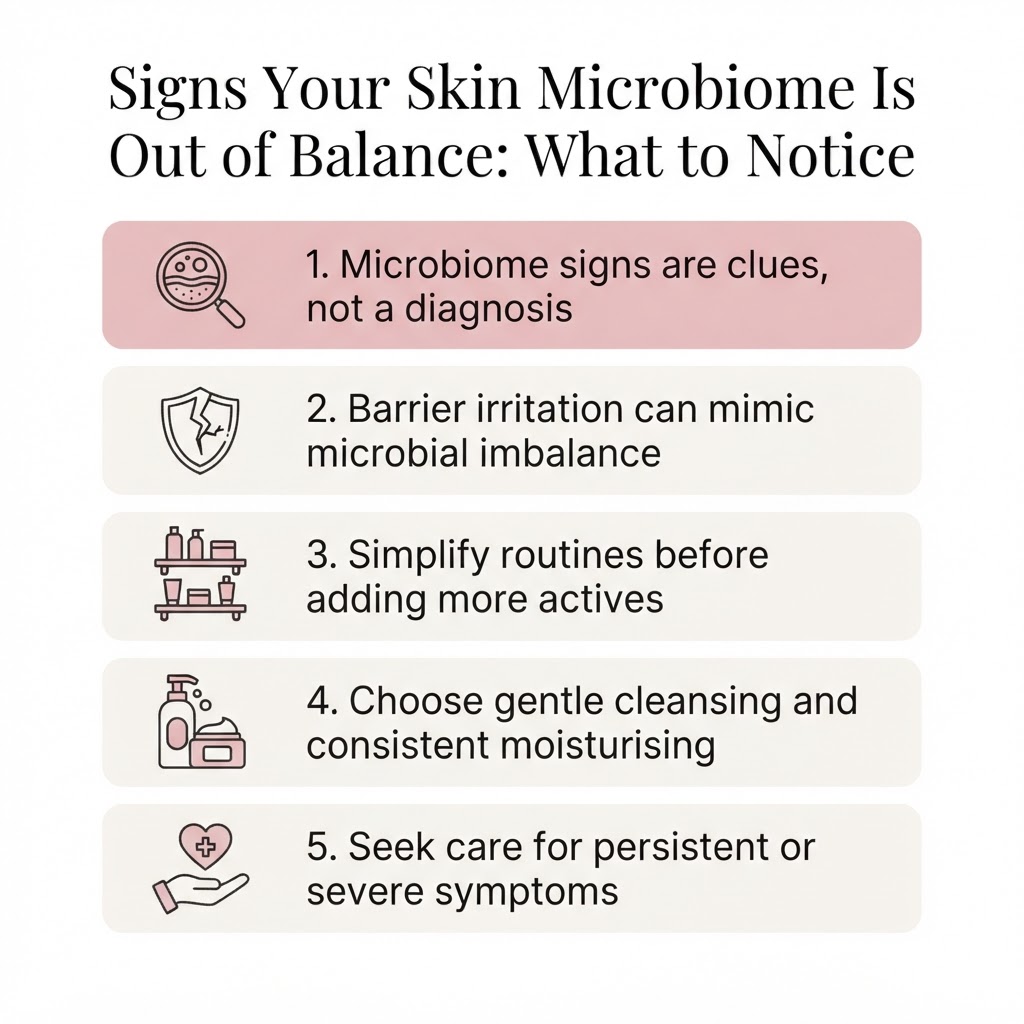
If your skin has become reactive, begin by simplifying rather than trying to “rebalance” it with a complicated protocol. Keep the routine familiar and give each change time to show its effect. A gentle approach can support the barrier while helping you identify potential triggers.
Build around three dependable steps
- Cleanse gently. Use lukewarm water and a mild, non-abrasive cleanser when needed. Avoid scrubbing, rough cloths and repeated washing that leaves skin tight.
- Moisturise consistently. Choose a texture you can use regularly. Ingredients such as glycerin and emollients can help attract or reduce the loss of water; the best choice depends on your skin and climate.
- Use daytime sun protection. A broad-spectrum sunscreen helps protect exposed skin from ultraviolet radiation. If you are prone to post-inflammatory marks, daily sun protection can be an important part of limiting their darkening.
Introduce one new product at a time, ideally when your skin is relatively settled. Follow its label, patch test when appropriate and stop using it if you develop a clear reaction. A patch test cannot rule out every allergy or irritation, but it can help you notice a problem before applying a product widely.
Consider pausing optional exfoliants, scrubs and strong actives if they are causing burning or peeling. Do not stop a prescribed medicine without speaking with the clinician who recommended it. Once your skin feels comfortable, any active ingredient can be reintroduced gradually if it suits your goals and a professional has not advised otherwise.
Choose products for the concern, not the label
Terms such as “microbiome-friendly” or “probiotic” are not a guarantee that a product will suit sensitive skin. Look at the full formula, fragrance and your own history of reactions. A serum may offer a lightweight step, while a moisturiser can provide the emollient support that a dry-feeling routine needs. Neither needs to be added simply because a symptom has appeared.
If you would like to explore Almasi’s approach, browse the Almasi probiotic skincare collection and select a product type that fits your current routine. Keep expectations measured: a cosmetic product can support skin care, but it cannot diagnose a condition or replace medical advice.
For people managing recurring eczema-prone areas, a simple, fragrance-conscious routine may be easier to tolerate. Our article on moisturising for eczema-prone skin offers additional context. Persistent itch, cracked skin, sleep disruption or signs of infection deserve assessment by a qualified clinician.
Different concerns need different interpretations
Adult acne-prone skin
Acne is not a sign of poor hygiene or proof of a microbial imbalance. Avoid aggressive cleansing in an attempt to remove oil; the resulting irritation can make a routine harder to maintain. If acne is painful, scarring, widespread or affecting your wellbeing, a doctor or dermatologist can discuss evidence-based options and help tailor them to your skin.
Eczema-prone or sensitive skin
Itch and recurring dry patches may fit an eczema pattern, but contact dermatitis, psoriasis and other conditions can look similar. Keep a note of possible triggers, including products, clothing friction and weather, and seek professional guidance if symptoms keep returning. Use any prescribed treatment as directed rather than relying on microbiome claims.
Hyperpigmentation and melanin-rich skin
Inflammation can leave marks in every skin tone, but post-inflammatory hyperpigmentation is often more noticeable and persistent in melanin-rich skin. Avoid picking and overly harsh treatments, which can create additional irritation. If uneven tone is a central concern, choose a gradual routine and ask a dermatologist about suitable options for your skin and medical history.
A change in pigmentation may be a trace of prior inflammation rather than an active microbiome issue. This distinction matters: treating a mark as if it were an infection can lead to unnecessary products and irritation. If a spot changes rapidly, has an unusual shape or causes concern, seek a medical assessment.
Ageing and changing skin needs
Skin often becomes drier or more easily irritated with age, although individual patterns vary. That does not mean ageing skin has an imbalanced microbiome. A routine built on gentle cleansing, moisturising and sun protection remains a useful foundation, with actives introduced according to tolerance and goals.
For related routine planning, see our article on an anti-ageing routine in your 30s. The central principle is the same: a steady routine that you can sustain is generally more useful than frequent product changes.
When to seek professional advice
Because the signs your skin microbiome is out of balance overlap with many common conditions, persistent symptoms are a reason to seek clarity rather than to self-diagnose. A primary-care clinician or dermatologist can examine the skin, ask about timing and exposures, and consider whether testing or a specific treatment plan is appropriate.
- Arrange an assessment if a rash, itch, burning or acne persists, worsens or repeatedly returns.
- Seek advice if symptoms interfere with sleep, daily activities or confidence, or if you are developing scars or lasting pigment changes.
- Get prompt care for rapidly spreading inflammation, significant pain, swelling, blistering, fever, or skin that appears infected.
- If a product causes a severe reaction, stop using it and seek urgent medical help when symptoms are serious or rapidly progressing.
Keep a short record of when symptoms started, what you applied, where the changes appeared and what made them better or worse. Photos taken in consistent lighting can help you track a pattern, especially when redness is subtle on your skin tone. This information is more useful to a clinician than a conclusion based on a product label or a single symptom.
Researchers are still learning how the skin microbiome differs across people and how topical interventions may influence it. The scientific conversation is active, but responsible skincare avoids overclaiming. A product may support a comfortable routine; it should not promise to correct every rash, breakout or pigment concern.
Your simplest first step: return to a gentle moisturising routine
If you are unsure where to begin, choose one simple step today: use a gentle moisturiser you already tolerate after cleansing, and pause unnecessary exfoliation while you observe your skin. Explore the Almasi skincare collection if you would like to find a product type that fits that uncomplicated routine.
Subscribe to the Almasi Journal for thoughtful, science-aware guidance on skin, ingredients and routines for every skin tone.