
Melanin-rich skin is beautifully diverse. It may be oily, dry, sensitive, acne-prone, eczema-prone, or some combination that changes with seasons, hormones and stress. A useful skincare routine for melanin rich skin is therefore not a special list of products prescribed by skin colour. It is a thoughtful way to protect the skin barrier, reduce avoidable irritation and choose care that makes sense for your own skin.
Melanin is the pigment that gives skin much of its colour and offers some natural protection against ultraviolet radiation. That protection is not complete, and it does not make sunscreen unnecessary. Melanin-rich skin can also be more prone to visible post-inflammatory hyperpigmentation: darkened patches that may follow acne, eczema, a scratch, or an irritating product.
In this guide, I’ll explain how the skin barrier and microbiome fit into everyday care, how to adapt products when your skin is reactive or breaking out, and how to build a simple morning and evening routine. The aim is not “perfect” skin. It is a calm, consistent plan that supports comfort and healthy-looking skin across different tones and concerns.
What melanin changes—and what it does not
Melanin is produced by cells called melanocytes. Those cells package pigment into structures that are transferred to surrounding skin cells. The amount, type and distribution of melanin influence skin tone, but they do not tell you whether someone’s skin is oily, sensitive, dehydrated or acne-prone.
One important difference is how inflammation can show on the skin. A red mark may be less obvious on brown or deep skin than it is on lighter skin. Inflammation may instead appear as warmth, swelling, tenderness, a change in texture, or a dusky, violet or darker patch. The signs vary between people, so pay attention to how your skin feels as well as how it looks.
When inflammation stimulates pigment production or changes how pigment is distributed, a darker mark can remain after the original spot settles. This is post-inflammatory hyperpigmentation (PIH). It is not dirt or a sign that the skin is unhealthy; it is a pigment response that can take time to fade. Repeated irritation can keep the cycle going, which is one reason gentleness matters.
- Melanin offers some UV protection, not immunity. Sun exposure can still contribute to skin damage and uneven tone.
- Dark marks can follow inflammation. Acne, eczema, friction and harsh products may all leave a visible trace.
- Skin tone is not a skin type. Choose products according to dryness, oiliness, sensitivity and your goals.
- Different signs deserve attention. New, changing or unusual spots should be assessed by a qualified clinician.
For more detail on pigment care, see our guide to fading dark spots on melanin-rich skin safely. The central idea is simple: address the trigger where possible, protect from UV exposure and avoid aggressive attempts to scrub pigment away.
The barrier and microbiome: the routine’s foundation
The skin barrier is the outermost protective layer of the skin. Its cells sit within a mixture of lipids—fats such as ceramides and cholesterol—that helps limit water loss and keeps irritants out. When the barrier is functioning well, skin is generally better able to stay comfortable and manage everyday exposure. When it is disrupted, tightness, flaking, stinging or sensitivity may become more noticeable.
The skin microbiome is the community of microorganisms that naturally live on the skin. It includes bacteria and other microbes, many of which are part of a healthy skin ecosystem. The microbiome is not something that needs to be “stripped clean.” Harsh cleansing, over-exfoliation and frequent product changes can disturb the surface environment, though the exact effects vary and the science is still developing.
Probiotic skincare is a broad marketing and formulation term. Topical products may contain live microorganisms, inactivated microbes, or ingredients derived from microbial fermentation; these are not interchangeable. Research is promising in some areas, but outcomes depend on the specific ingredient, formula and skin concern. A product described as probiotic should be viewed as one possible part of a routine, not a substitute for medical care or a guarantee of results.
To understand the language and evidence in more detail, read What Is the Skin Microbiome Explained Simply? and What Is Probiotic Skincare and Does It Work?. For a scientific overview of topical microbiome research, see this review in the Journal of Dermatological Science.
“The skin microbiome is a complex ecosystem shaped by the host and the surrounding environment.”
— Byrd, Belkaid and Segre, Nature Reviews Microbiology, 2018
In practice, barrier-supportive care is often less complicated than the language used to sell it. Cleanse without a squeaky-clean finish, moisturise to reduce dryness, and add actives only when your skin has a clear reason for them. That foundation can be useful whether your main concern is uneven tone, occasional blemishes or sensitivity.
A simple routine, built in the right order
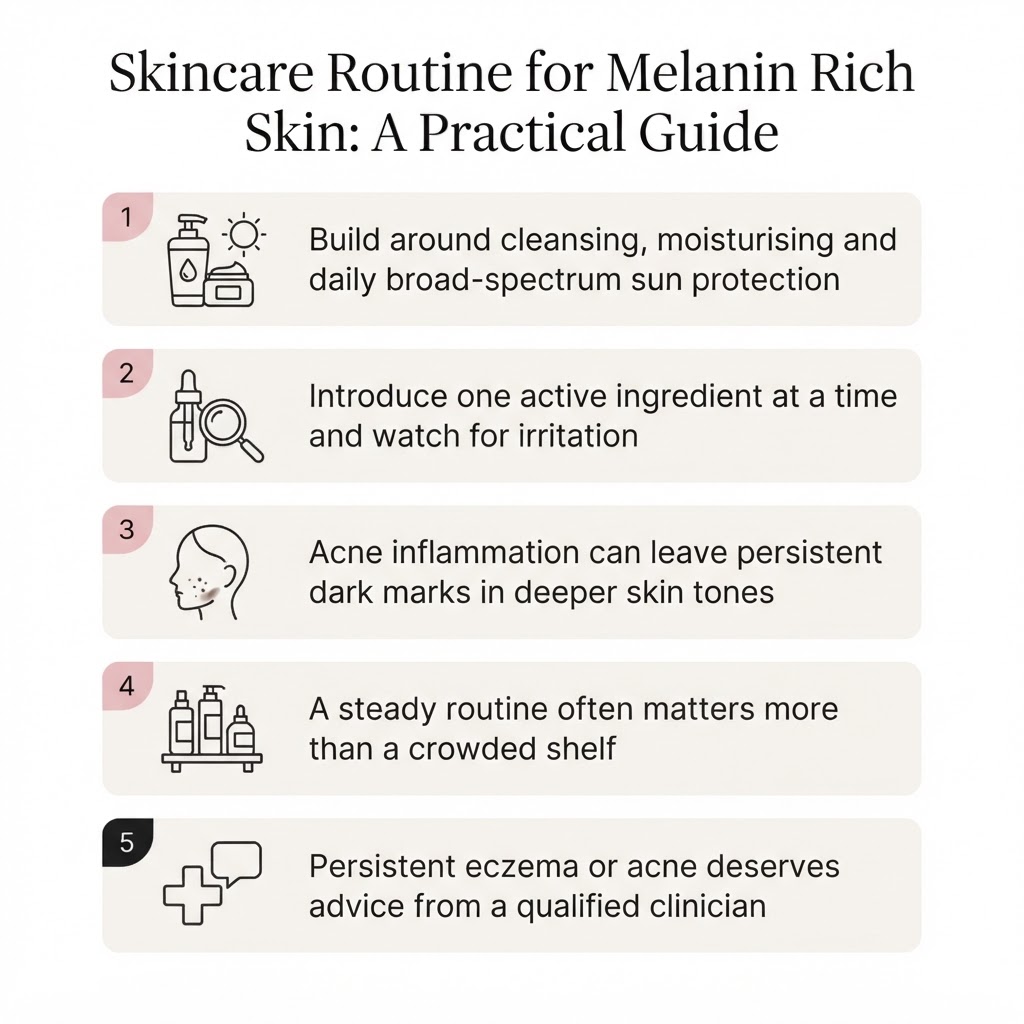
A skincare routine for melanin rich skin should be easy enough to repeat. Start with a few basics for several weeks before deciding whether you need more. Introduce one new product at a time, and patch test it on a small area according to the product directions; a patch test cannot rule out every reaction, but it can offer an early warning.
Morning: protect and moisturise
- Cleanse gently, or rinse. If your skin is dry or sensitive, lukewarm water may be enough in the morning. If you prefer a cleanser, choose one that leaves your skin comfortable rather than tight.
- Apply a targeted serum if it suits you. A serum is an optional step, not a requirement. Start with one product and follow its directions; avoid layering several strong actives at once.
- Moisturise. Use a texture that feels comfortable. A lighter lotion may suit oily skin, while a richer cream may be more comfortable for dry areas.
- Finish with broad-spectrum sunscreen. Choose SPF 30 or higher and apply generously to exposed skin. Reapply as directed, particularly after swimming, sweating or prolonged outdoor time.
Evening: cleanse and support recovery
- Remove sunscreen and makeup. A gentle cleanser is usually enough; avoid scrubbing with rough cloths or abrasive tools.
- Use one treatment, if needed. Depending on your concern, a clinician may suggest an ingredient such as a retinoid or azelaic acid. Start gradually and do not use irritating actives on eczema flares or broken skin unless advised by a professional.
- Apply moisturiser. Use it consistently, especially if an active ingredient makes your skin feel dry. If a product causes ongoing burning, swelling or a rash, stop using it and seek advice.
We recommend thinking in terms of a routine, not a product count. If you are exploring a probiotic option, you can view Almasi probiotic serum as one possible serum step. Check the ingredient list and directions, and consider whether it fits your skin’s needs before adding it.
For sunscreen, formulation preference matters because the best sunscreen is one you can apply sufficiently and use regularly. Some people prefer tinted formulas, which may also help reduce the visible cast some sunscreens leave on deeper skin tones. If you have a history of pigment concerns, a dermatologist can help you choose a suitable option.
Adapting care for acne, eczema and uneven tone
Acne-prone adult skin can be frustrating, particularly when each spot leaves a mark. Acne is influenced by several factors, including oil production, clogged pores, inflammation and hormonal changes. A routine cannot address every cause, but it can avoid making irritation worse and can support consistent use of evidence-based care.
If you are acne-prone
- Choose a gentle cleanser and a non-comedogenic moisturiser if those labels help you compare options; individual reactions still vary.
- Avoid picking, squeezing and frequent scrubbing. These can increase inflammation and raise the chance of a lingering mark.
- Introduce acne-focused ingredients slowly. Benzoyl peroxide, salicylic acid and retinoids are common options, but suitability depends on your skin and health circumstances.
- Seek professional guidance for painful, deep, persistent or scarring acne. Early advice may help reduce ongoing inflammation and its pigment consequences.
Acne treatments can be drying or irritating, especially when combined. Using several active ingredients at the same time does not necessarily speed progress. If your skin becomes persistently sore or flaky, scale back and ask a pharmacist, GP or dermatologist how to adjust the plan.
If your skin is eczema-prone or reactive
Eczema-prone skin may have a more easily disrupted barrier, and symptoms can fluctuate. During a flare, a short, familiar routine is often preferable to experimenting with new serums, exfoliants or fragranced products. Follow your clinician’s advice for managing eczema; cosmetic skincare can support comfort but does not replace prescribed care.
- Use lukewarm water and a mild, fragrance-free cleanser where possible.
- Apply a bland moisturiser regularly, including after washing, if that suits your care plan.
- Pause exfoliating acids, retinoids and other potentially irritating products on affected areas until the skin is settled and a clinician advises what is appropriate.
- Ask for medical advice if a rash is widespread, painful, infected-looking, affecting sleep, or not improving with your usual plan.
For a closer look at moisturising choices and eczema-prone skin, visit our barrier guide for eczema-prone skin. Persistent or severe eczema should be assessed by a healthcare professional rather than managed with cosmetic products alone.
If uneven tone is your main concern
With dark marks, the first task is to reduce repeat inflammation. That may mean finding a manageable acne plan, avoiding a product that stings, or addressing friction from clothing or hair removal. Sunscreen is important because UV exposure can make uneven pigmentation more noticeable or persistent.
Do not try to remove marks by scrubbing, using undiluted acids, or applying household remedies. These approaches can irritate skin and may deepen discolouration. Ingredients used for uneven tone, including azelaic acid or retinoids, can be helpful for some people but may also irritate; the right choice depends on your skin and medical history.
“The best sunscreen is the one you will use again and again.”
— American Academy of Dermatology, Sunscreen FAQs
The American Academy of Dermatology offers practical advice on sunscreen use and sun protection. For evidence about how acne and pigmentary disorders can present across skin tones, consult the peer-reviewed review Dermatology for Skin of Color.
Ageing well: consistency, comfort and realistic expectations
Ageing is a normal process shaped by genetics, environment and time. Changes may include fine lines, reduced elasticity, dryness or uneven tone, and they occur in all skin tones. Melanin can offer some protection from UV-related changes, but it does not prevent all sun-associated damage, and it does not make prevention irrelevant.
For many people, the most useful long-term steps are simple: daily sun protection, a moisturiser that supports comfort, and a routine they can sustain. Some people may choose a retinoid for concerns such as texture or fine lines. Retinoids are not suitable for everyone, can irritate, and should be discussed with a clinician if you are pregnant, trying to become pregnant, or managing a skin condition.
Serums can add a targeted step, but the word “serum” describes a product format, not a guaranteed result. Look at the full ingredient list, directions and your tolerance. If your skin is already reactive, start with fewer products rather than chasing multiple benefits at once.
A helpful rule is to change one variable at a time. If you add a new serum and a new exfoliant in the same week, it becomes difficult to know what is helping or causing discomfort. Keep a brief note of what you use and how your skin feels; this can make conversations with a clinician more useful, too.
Common mistakes—and when to ask for help
When a routine is not working, it is tempting to add more. Yet irritation can disguise itself as “purging,” sensitivity can accumulate gradually, and a persistent rash or acne pattern may need medical care. A skincare routine for melanin rich skin should be responsive, not punishing.
- Using too many actives at once: simplify, then reintroduce products gradually if appropriate.
- Exfoliating to remove dark marks: pigment is not a surface stain, and over-exfoliation may worsen irritation.
- Skipping moisturiser because of oily skin: an appropriate lightweight moisturiser may still be comfortable and useful.
- Assuming sunscreen is only for lighter skin: sun protection remains relevant for every skin tone.
- Expecting overnight change: skin responses take time, and pigment may take longer to fade than the original blemish took to settle.
Arrange professional advice if acne is painful, persistent or scarring; eczema is affecting daily life; or a product reaction is severe or ongoing. A dermatologist can assess the condition, discuss treatment options and help tailor a plan to your skin tone and concerns. Seek prompt medical attention for sudden swelling, breathing difficulty or a rapidly worsening reaction.
Keep the basics steady while you seek advice, but do not continue a product that appears to cause a significant reaction. A good routine should feel manageable, and it should leave room for professional care when needed.
Your simplest first step: keep it gentle
Start by choosing one gentle cleanser you can use comfortably, then keep the rest of your routine familiar while you notice how your skin responds. Explore Almasi skincare if you would like to consider a cleanser or serum as part of that simple routine.
Subscribe to the Almasi Journal for thoughtful, science-aware guidance on skin, ingredients and everyday routines.