
If you have ever wondered, what is the skin microbiome explained simply, picture a busy neighbourhood living on your skin. It includes bacteria, fungi, viruses, and other tiny organisms, alongside the conditions that shape how they live together. Most are harmless or helpful residents; their presence is not a sign that your skin is dirty.
I’m Dr. Chomba Chuma, MD, founder of Almasi. In this guide, I’ll explain what the skin microbiome does, how it relates to the skin barrier, and what practical skincare choices may support a more comfortable, resilient complexion. The goal is not to sterilise the skin or chase a supposedly perfect microbial profile. It is to understand the ecosystem and care for the skin in ways that make sense for you.
What the skin microbiome means
The skin microbiome is the community of microorganisms that inhabit the skin’s surface and its folds, pores, and hair follicles. The word “microbiome” is also used to describe their collective genetic material and the local environment in which they live. You may see “microbiota” used for the organisms themselves.
People carry different microbial communities. Those communities can vary by body site, age, climate, hormones, and everyday habits. The moist crease of an elbow is a different habitat from an oily area of the face or a dry forearm, so it makes sense that their resident communities differ too.
In other words, what is the skin microbiome explained simply? It is an ever-changing ecosystem, not one species or a layer you can scrub clean. Microbes interact with one another and with skin cells, oils, sweat, and the surrounding environment. Scientists continue to study these relationships; there is no single ideal mix that applies to every person.
- Bacteria are common skin residents, with many different types and strains.
- Fungi are also part of the normal community, particularly in some skin areas.
- Viruses and other microscopic organisms can be present as well.
- Skin conditions, including moisture, acidity, oil, and temperature, influence which organisms thrive.
Microbes are not automatically good or bad. A species that is a normal resident in one context may behave differently under changed conditions, and the same organism can have different strains. That is why broad claims such as “all bacteria are harmful” or “more bacteria are always better” miss the complexity.
How microbes and the skin barrier work together
The skin barrier is the outer protective system that helps limit water loss and shields deeper tissues from irritants, allergens, and environmental stress. Its outermost layer, the stratum corneum, is often compared to bricks and mortar: skin cells are the bricks, while lipids—fat-like molecules—help fill the spaces between them. The barrier also includes immune activity and the skin’s surface chemistry.
Resident microorganisms live alongside this barrier. Research suggests they may compete with incoming microbes for space and resources, interact with immune signals, and contribute to the local chemical environment. These are active areas of research, not a reason to assume that one skincare product can control every part of the ecosystem.
“The skin microbiome is highly variable across individuals and body sites.”
— Byrd, Belkaid and Segre, 2018
When the barrier is functioning well, skin generally holds onto moisture more effectively and is better equipped to withstand ordinary exposure. When it is stressed, skin may feel tight, sting, flake, or become more reactive. Those experiences can be influenced by many factors—including cleansing habits, weather, underlying conditions, and medication—not simply by a change in microbes.
Understanding what is the skin microbiome explained simply also means recognising that barrier and microbiome are related but not interchangeable. A moisturiser can support hydration and barrier comfort without necessarily changing microbial diversity. Conversely, a product marketed as microbiome-friendly cannot replace appropriate care for a persistent skin condition.
To explore the barrier in greater depth, read our guide to the science of skin barrier repair. For the product category and evidence behind probiotic skincare, see what probiotic skincare is and what research suggests.
What can disrupt the ecosystem—and what does not
The skin microbiome is not a fragile glass ornament that one face wash will shatter. It is dynamic and responds to changes in the skin’s environment. Still, repeatedly stripping the skin, exposing it to irritating products, or using harsh routines can make skin feel uncomfortable and affect barrier function.
- Over-cleansing: Washing more often or more aggressively than your skin needs can remove surface oils and increase dryness or tightness.
- Harsh or poorly tolerated products: Strong exfoliants, fragrance, or multiple new actives may irritate some people, especially when introduced together.
- Climate and lifestyle: Cold air, low humidity, heat, sweat, pollution, and frequent bathing can alter the skin’s immediate environment.
- Medication and health changes: Hormones, prescribed treatments, illness, and age can affect skin and its microbial community.
- Skin conditions: Acne, eczema, and other inflammatory conditions can involve complex interactions between the barrier, immune system, and microbes.
That does not mean you must avoid cleansing, exfoliation, or active ingredients. It means the right amount depends on your skin, the product, and how you use it. If your face is persistently burning, swollen, cracking, or intensely itchy, pause potential irritants and seek advice from a qualified healthcare professional rather than trying to diagnose a microbiome imbalance at home.
It is also important not to confuse “natural” with universally gentle. Plant extracts and essential oils can irritate or trigger allergy in some people; carefully formulated products can be appropriate whether their ingredients are natural or synthetic. Patch testing a new product on a small area is a practical precaution, though it cannot predict every possible reaction.
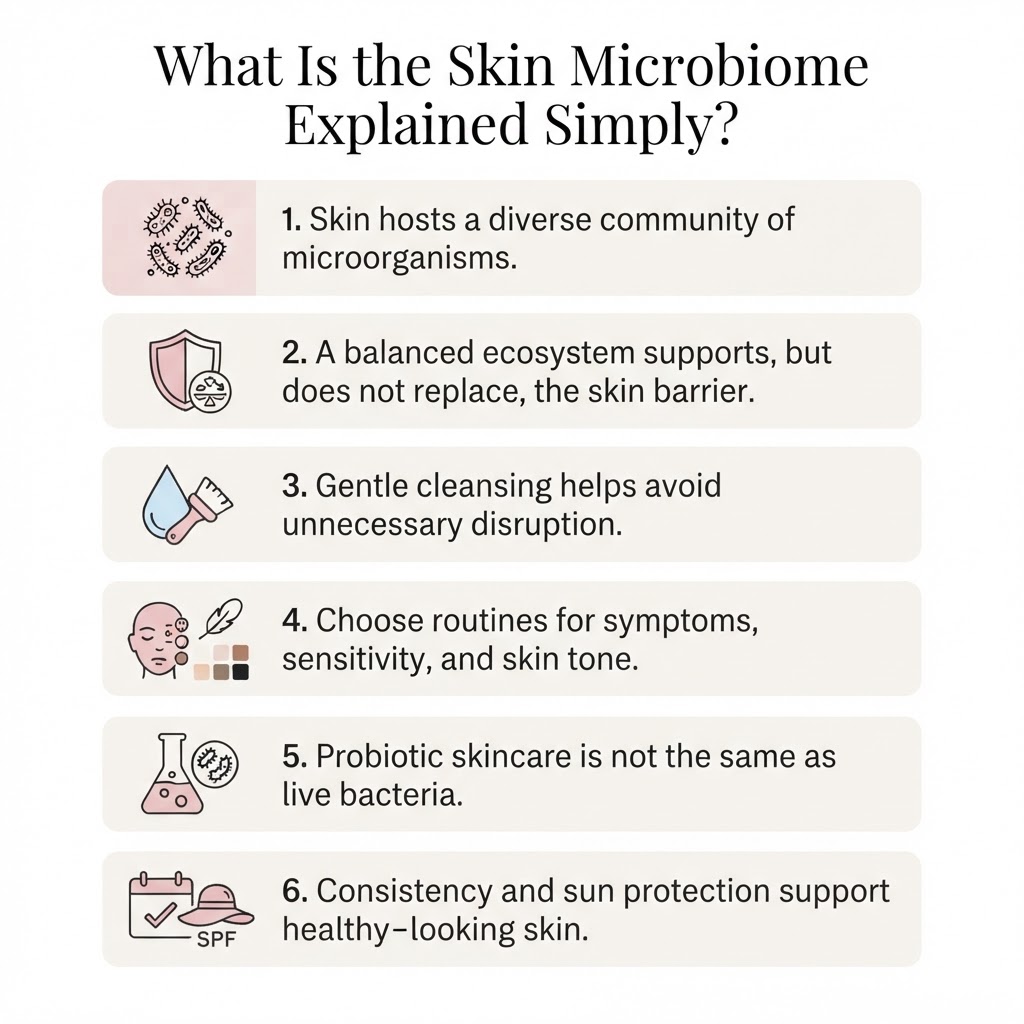
Acne, eczema, pigmentation, and ageing: a careful perspective
Adult acne-prone skin
Acne is not caused by being unclean, and it is not simply a problem of “bad bacteria.” It involves several processes, including clogged follicles, oil production, inflammation, and hormonal influences. Some research examines how particular strains of Cutibacterium acnes relate to acne, but the presence of the species alone does not explain why one person develops breakouts and another does not.
A microbiome-aware routine for acne-prone adult skin can still be straightforward. Use a gentle cleanser, a moisturiser that suits your skin, and sunscreen in the morning. If you use acne ingredients, introduce one at a time and follow product directions; a dermatologist can help choose options when breakouts are persistent, painful, or leaving marks.
Eczema-prone skin
Eczema, including atopic dermatitis, involves a compromised barrier and immune-system activity. Studies have found associations between flares and changes in the skin’s microbial community, including increased dominance of certain bacteria in some settings. An association is not proof that a microbiome shift is the sole cause, and eczema care should be guided by a clinician when symptoms are ongoing.
For easily irritated skin, consistency often beats complexity: a mild cleanser when needed, a bland moisturiser, and fewer unnecessary product changes. Do not apply a new product to inflamed or broken skin without professional guidance. Our article on moisturiser considerations for eczema-prone skin offers more context.
Hyperpigmentation and melanin-rich skin
Inflammation from acne, irritation, or other skin problems can leave dark marks known as post-inflammatory hyperpigmentation. Melanin-rich skin can develop more noticeable or longer-lasting marks after inflammation, though people of every skin tone can experience them. The practical priority is reducing avoidable irritation, addressing the cause where possible, and using sun protection suited to your preferences and routine.
The skin microbiome is not a shortcut for fading dark spots, and no single microbial profile guarantees an even tone. If marks are a concern, see our guide on fading dark spots safely on melanin-rich skin. A healthcare professional can help distinguish post-inflammatory marks from other pigmentation concerns.
Ageing and changing skin
Skin changes with age: it may become drier, thinner, or more sensitive, and its surface environment can change too. Researchers are investigating how ageing and microbial communities influence one another, but this science is still developing. A moisturiser can help with dryness, and daily sun protection is a practical measure for reducing cumulative ultraviolet exposure; neither should be presented as a way to “reset” the microbiome.
Across these concerns, what is the skin microbiome explained simply is a useful question, but it is not a diagnosis. Skin symptoms have overlapping causes, and a product described as microbiome-supportive should not replace medical care when symptoms are persistent or severe.
Probiotic skincare: what the label can and cannot tell you
“Probiotic skincare” is a broad term. In food science, a probiotic generally refers to live microorganisms that provide a health benefit when consumed in an adequate amount. Topical products may instead contain live organisms, inactivated microbes, or ingredients derived from microbes, such as ferments and lysates. These are not interchangeable, and a label does not by itself establish what a formula does on skin.
Many cosmetic formulas need to remain stable and safe during storage. That can make the idea of live bacteria in a conventional skincare product more complicated than it sounds. Products containing postbiotic or ferment-derived ingredients are not necessarily delivering living organisms; their effect depends on the ingredient, the formula, and the available evidence.
“The skin microbiome is a complex ecosystem that contributes to skin health.”
— Grice and Segre, 2011
Research into topical microbiome approaches is promising in some areas, but it is not a blanket endorsement of every product using “probiotic,” “prebiotic,” “postbiotic,” or “microbiome-friendly” on its packaging. Look for transparent ingredient information, sensible claims, and a formula that fits your skin’s tolerance. The review on the skin microbiome by Grice and Segre provides a useful scientific overview of the field.
At Almasi, Velobiotics™ describes the technology behind our probiotic skincare approach. If you are curious, explore Almasi probiotic serum and skincare as one possible part of a routine, not as a medical treatment or a requirement for healthy skin. Choose based on your needs and ingredient tolerance rather than the promise of a particular buzzword.
For more background, the review of the skin microbiome and its role in dermatology discusses how microbial communities relate to skin health and disease. The evidence base continues to evolve, and findings about one species, strain, or product cannot automatically be applied to all products or all people.
A simple routine that respects your skin
You do not need a complicated routine to care for the skin ecosystem. Start with products that support your basic needs and add optional steps slowly. If you already have a routine that feels comfortable and works for you, there is no need to replace it because of a microbiome trend.
Morning
- Rinse with water or use a gentle cleanser if you prefer or need one.
- Apply a moisturiser if your skin feels dry or tight.
- Use broad-spectrum sunscreen that you are comfortable wearing consistently, following the label directions.
Evening
- Cleanse gently to remove sunscreen, makeup, sweat, and daily residue.
- Use one optional serum or active ingredient at a time, if it suits your goals.
- Finish with a moisturiser suited to your skin’s comfort and climate.
For acne-prone skin, resist the urge to stack multiple exfoliants or drying products simply because a breakout has appeared. For eczema-prone or easily reactive skin, prioritise fragrance-free, well-tolerated basics where possible and seek clinical advice for recurring flares. For melanin-rich skin, the same gentle principles apply; pay attention to irritation because inflammation can be followed by visible dark marks.
When introducing a serum or moisturiser, try one new product at a time and give yourself a chance to notice how your skin responds. Keep the rest of the routine steady during that trial. Stop using a product if it causes significant irritation, and ask a clinician or pharmacist for advice if the reaction is concerning.
There is no need to disinfect healthy skin, use antibacterial products routinely, or chase a specific microbiome reading. The American Academy of Dermatology’s guidance on building a practical skincare routine reinforces the value of simple, consistent care over an elaborate shelf of products.
Your simplest first step
Choose one gentle cleanser or moisturiser that your skin tolerates and use it consistently before adding anything new; when you are ready to explore a product, browse Almasi skincare and select the product type that fits your routine. Subscribe to the Almasi Journal for thoughtful, evidence-aware guidance on skin and skincare.