
When skin feels tight, rough, reactive or unexpectedly congested, the solution is rarely a more aggressive routine. The more useful question is whether the skin barrier and its microbial community have enough support to function well. This is where a probiotic moisturiser for eczema-prone skin can become a thoughtful part of a simple, consistent routine—provided it is chosen for comfort, formulation quality and individual tolerance.
I’m Dr Chomba Chuma, MD and founder of Almasi. My approach begins with a practical principle: skin is a living ecosystem, not a blank surface waiting to be scrubbed into perfection. A well-designed routine should reduce unnecessary disruption while supplying water-binding ingredients, barrier-supportive lipids and carefully selected microbiome-conscious technology.
This guide explains how probiotic skincare fits into barrier repair, how to build a routine for acne-prone adult skin, eczema-prone skin, pigmentation and ageing, and how to adapt the basics for every skin tone, including melanin-rich skin. It is educational rather than medical advice, and persistent inflammation, cracking, bleeding or intense itch deserves assessment by a qualified healthcare professional.
Why the skin barrier and microbiome belong in the same conversation
The outermost layer of skin is often described as a brick-and-mortar structure. Corneocytes—the flattened cells sometimes called skin-cell “bricks”—are surrounded by lipids including ceramides, cholesterol and fatty acids. Together, they help limit excessive water loss and reduce the penetration of potential irritants.
The skin microbiome is the community of microorganisms living on the skin’s surface. These organisms are not automatically harmful; many coexist with us and interact with the local environment. Their balance is influenced by sweat, sebum, pH, climate, cleansing habits, age and the products applied to the skin.
Barrier disruption and microbiome disruption can reinforce one another. When the barrier becomes less effective, water escapes more readily and irritants may feel more noticeable. When the surface environment changes, the microbial community may also shift, which can contribute to discomfort and visible reactivity in susceptible people.
That does not mean every flare, spot or dry patch is caused by the microbiome. Skin is influenced by genetics, hormones, immune activity, medication, stress, allergens and environmental exposure. Microbiome-conscious skincare is best understood as one supportive strategy within a broader routine, not a substitute for diagnosis or prescribed care.
“The skin microbiome is a complex ecosystem that contributes to skin health and disease.”
— Grice and Segre, Nature Reviews Microbiology, 2011
Research continues to develop, but the practical takeaway is already useful: avoid treating the skin surface as an enemy. Excessive cleansing, frequent exfoliation and fragranced products may be poorly tolerated when the barrier is vulnerable. Gentle, repeatable care often gives the skin a better chance to settle.
- Use lukewarm rather than very hot water, especially during dry winter weather.
- Keep cleansing brief and avoid scrubbing with face cloths, brushes or exfoliating gloves.
- Moisturise soon after washing, while the skin still feels slightly damp.
- Notice environmental influences such as indoor heating, air-conditioning, wind and low humidity.
In South Africa, routines may need to change with location and season. A dry Highveld winter can increase tightness, while humid coastal weather may make a lighter lotion more comfortable. Sun exposure is also significant across the country, so barrier support should sit alongside daily broad-spectrum sunscreen.
What probiotic skincare actually means
“Probiotic” traditionally refers to live microorganisms administered in adequate amounts to confer a health benefit. In topical skincare, however, products may use a broader microbiome-inspired vocabulary. A formula can contain live organisms, non-living bacterial components, ferments or lysates—ingredients derived from microorganisms but not necessarily containing living bacteria.
Because terminology varies, read the ingredient list and the brand’s technical explanation rather than relying on the front label alone. A product should also explain how it is preserved and packaged. Live cultures can be challenging to stabilise, while postbiotic-style ingredients may offer formulation advantages and are often easier to incorporate consistently.
Prebiotics, probiotics and postbiotics
- Probiotics: live microorganisms intended to provide a benefit when used appropriately.
- Prebiotics: substrates that can support selected microorganisms, although topical definitions are still evolving.
- Postbiotics: non-living microbial components or metabolites that may interact with the skin environment.
- Ferments and lysates: processed ingredients derived from microorganisms and used for their formulation or skin-conditioning properties.
Velobiotics™ technology is Almasi’s microbiome-conscious approach to topical formulation. The goal is not to promise a perfect microbial population. It is to create elegant products that respect the surface ecosystem while supporting hydration, comfort and the appearance of a stronger barrier.
For a deeper foundation, read our article on The Science of Skin Barrier Repair: How to Rebuild What Modern Life Destroys. The most important distinction is between supporting the skin and overwhelming it with a crowded routine.
When evaluating a product, consider practical questions as well as scientific language:
- Are the ingredients clearly listed?
- Does the packaging help protect the formula from air, light and contamination?
- Does the product explain whether its microbial-derived ingredients are live, fermented or non-living?
- Is the claim modest and cosmetic, or does it suggest that one product can replace professional care?
- Can you use it comfortably and consistently in your climate?
How to choose a probiotic moisturiser for eczema-prone skin
A probiotic moisturiser for eczema-prone skin should be judged by the whole formula, not by one fashionable ingredient. Eczema-prone skin may be dry, itchy, reactive or easily irritated, but individual triggers differ. A product that feels comfortable for one person can still be unsuitable for another.
Start with texture and tolerance. Creams and richer emulsions may feel more protective when dryness is prominent, while lighter lotions can be preferable in warm climates or for people who dislike occlusive finishes. The best moisturiser is one you can apply consistently without stinging, excessive shine or a feeling of suffocation.
Ingredients worth looking for
- Humectants: glycerin, hyaluronic acid and panthenol attract and hold water in the outer layers.
- Emollients: oils, esters and fatty materials smooth rough areas and improve softness.
- Barrier lipids: ceramides, cholesterol and fatty acids can complement the skin’s lipid architecture.
- Occlusives: ingredients such as petrolatum or certain waxes help reduce water loss by forming a protective film.
- Microbiome-conscious components: ferments, lysates or other carefully selected microbial-derived ingredients may support a comfortable surface environment.
What to approach carefully
- Strong fragrance or essential oils, especially if your skin regularly stings.
- High-strength exfoliating acids during periods of dryness or visible irritation.
- Frequent product switching, which makes it difficult to identify a trigger.
- Very hot water, vigorous cleansing and rough towels.
- Marketing claims that imply one product can replace medical eczema care.
Patch testing is sensible. Apply a small amount to an area such as the inner forearm or behind the ear for several days, then introduce the product to the face if the area remains comfortable. A patch test cannot predict every reaction, but it is a useful risk-reduction step.
For everyday use, begin with a small amount and spread it gently rather than massaging until the skin feels heated. Apply after bathing, handwashing or cleansing when the surface is slightly damp. If your hands are affected, keep a tube nearby so moisturising does not depend on remembering to return to the bathroom.
Families should also consider age and routine. Children may need especially simple products, while adults who wash their hands frequently may benefit from applying moisturiser after work, exercise and household chores. In a South African summer, a lighter cream may be easier to use during the day, with a richer layer reserved for night or very dry areas.
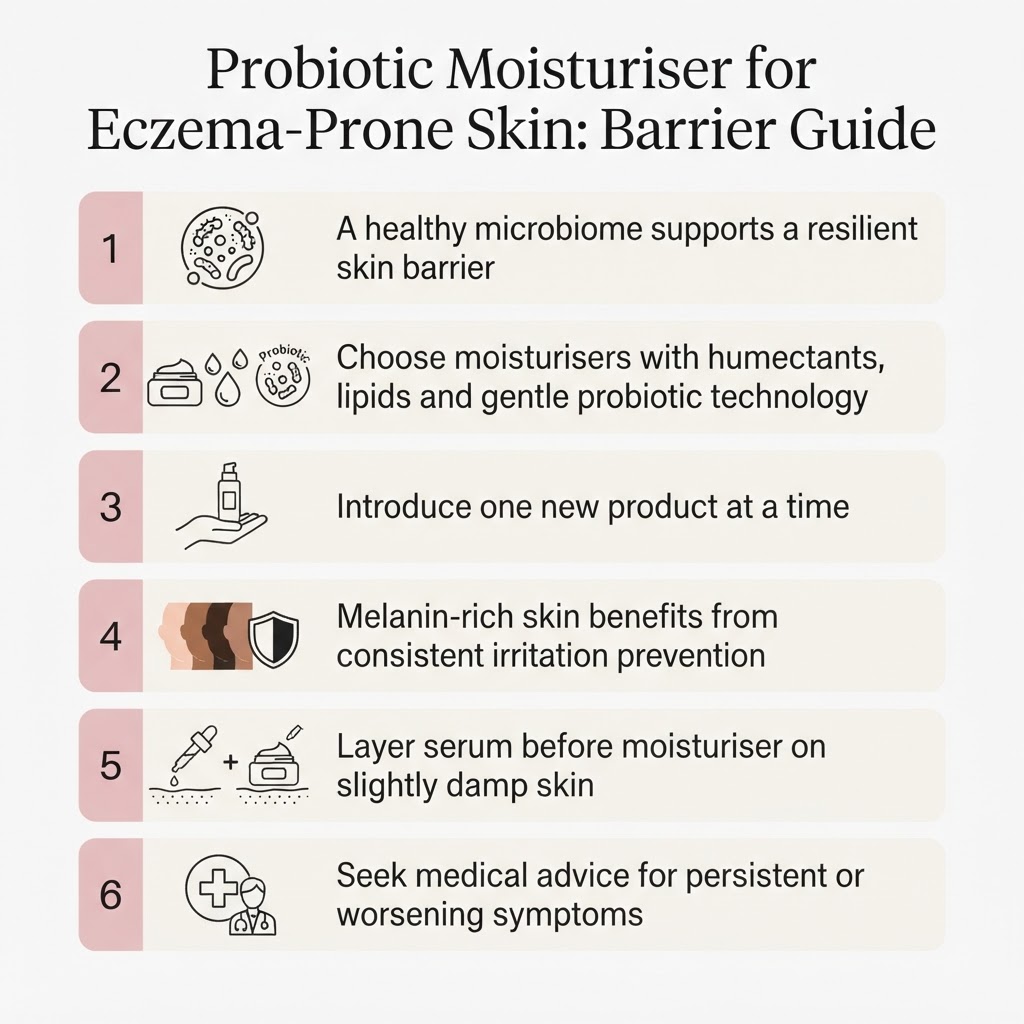
Barrier-first routines for acne-prone adult skin and eczema-prone skin
Adult skin can be simultaneously oily, blemish-prone and dehydrated. This is not contradictory: sebum production concerns oil, while dehydration concerns water content. Over-cleansing acne-prone skin can increase tightness and discomfort without addressing the biological drivers of breakouts.
A simple morning routine
- Cleanse gently: use a low-foaming or non-stripping cleanser, or simply rinse if your skin tolerates that in the morning.
- Apply a serum: choose a hydrating or antioxidant formula that does not sting. Almasi’s Almasi probiotic serum can be layered according to your skin’s comfort.
- Moisturise: press a suitable moisturiser over slightly damp skin rather than rubbing aggressively.
- Protect: apply broad-spectrum sunscreen generously and reapply as directed, especially outdoors.
A simple evening routine
- Remove sunscreen and makeup with a gentle cleanser; cleanse twice only when genuinely necessary.
- Use one targeted serum if your skin is calm and the product is well tolerated.
- Finish with a probiotic moisturiser for eczema-prone skin or another barrier-supportive moisturiser matched to your needs.
If acne is your main concern, keep the routine steady before adding multiple actives. Salicylic acid, retinoids and benzoyl peroxide can be useful in appropriate circumstances, but they may increase dryness or irritation. Introduce only one active at a time, use it at a sensible frequency and discuss persistent or scarring acne with a dermatologist.
If eczema-prone areas are actively inflamed, simplify further. Use lukewarm water, a gentle cleanser when needed and a bland moisturiser that feels comfortable. A probiotic moisturiser for eczema-prone skin may support daily comfort, but it should not replace a clinician’s plan for recurring flares or suspected infection.
“Moisturizers are an important component of care for patients with atopic dermatitis.”
— American Academy of Dermatology, Atopic Dermatitis Guidelines
A useful weekly approach is to review your routine rather than constantly reinvent it:
- Write down any new product and the date you introduced it.
- Change only one variable at a time.
- Pause exfoliation if cleansing or moisturising begins to sting.
- Do not use a scrub to remove flaking; soften the area with moisturiser instead.
- Wash pillowcases, makeup tools and reusable cloths regularly without assuming that “squeaky clean” skin is the goal.
Hyperpigmentation, ageing and melanin-rich skin: why gentleness matters
Inflammation can leave behind a change in colour known as post-inflammatory hyperpigmentation. It can affect any skin tone, but the contrast may be more noticeable in melanin-rich skin. Preventing unnecessary irritation is therefore not merely a comfort goal; it is also part of a pigmentation-conscious routine.
Consistency matters more than intensity. A moisturised, comfortable surface is generally more receptive to a routine that includes sunscreen and carefully selected pigment-supporting ingredients. If every new active causes burning or peeling, the resulting inflammation can work against the appearance you want.
A barrier-supportive routine can also complement an ageing routine. With age, skin may become drier, thinner-feeling or slower to recover from environmental stress. Hydration improves the look of fine surface lines temporarily, while sunscreen helps reduce ongoing ultraviolet exposure. Retinoids and other actives may have a place, but tolerance should determine pace.
Adapting the routine across skin tones
- Prioritise daily broad-spectrum sunscreen, including on days when pigmentation is the main concern.
- Do not wait for visible peeling before reducing an irritating active.
- Choose moisturiser texture according to climate, oiliness and comfort—not skin tone alone.
- Take new redness, grey-brown patches or persistent irritation seriously.
- Remember that sunscreen can leave a cast; tinted mineral formulas may be more cosmetically comfortable for some deeper skin tones.
For antioxidant education, explore Why Vitamin C Serum Is Your Skin’s Most Powerful Antioxidant Shield. Vitamin C may be useful for some routines, but the best serum is one that complements, rather than destabilises, your barrier.
South African sunlight can be intense even during cooler months, and daily commuting, sport, gardening and outdoor work can add substantial exposure. Apply sunscreen to commonly missed areas such as the ears, neck, hairline and backs of the hands. Hats, shade and protective clothing are practical additions, particularly around midday.
How to layer serums and moisturisers without overwhelming your skin
Layering is simple when each step has a clear purpose. Apply products from the thinnest comfortable texture to the richest, allowing a brief pause between layers if pilling occurs. You do not need a long interval between every product; the main goal is even application without excessive rubbing.
- Cleanser: removes sunscreen, makeup, excess oil and surface debris.
- Essence or mist: adds light hydration if you enjoy this step; it is optional.
- Serum: delivers a focused cosmetic benefit, such as hydration or antioxidant support.
- Moisturiser: adds water-binding, smoothing and water-loss-reducing support.
- Sunscreen: the final morning skincare step before makeup.
On reactive days, remove steps rather than adding more. A cleanser, moisturiser and sunscreen can be a complete routine. When skin is calm, add one serum and observe how it behaves for at least a couple of weeks before making another change.
Keep packaging closed, avoid dipping wet fingers into jars and follow storage instructions. Preservatives are not automatically problematic; they help protect water-based products from contamination. The question is whether the complete formula is well made, well tolerated and appropriate for your skin.
- Apply watery serums with clean, dry hands.
- Use enough moisturiser to cover the area without creating a thick, uncomfortable film.
- Allow skincare to settle before applying makeup if pilling is an issue.
- Store products away from direct sun and excessive heat, especially in warmer regions.
- Discard products that change smell, colour or texture unexpectedly.
What to expect—and when to seek professional advice
Hydration and softness may improve relatively quickly, while the appearance of uneven texture can take longer. Pigment concerns often require consistent sunscreen and patience. A moisturiser can support the conditions for comfort, but it cannot address every cause of acne, dermatitis or discolouration.
Stop a new product and seek medical guidance if you develop marked swelling, blistering, widespread hives, severe pain, oozing or breathing difficulty. Persistent itch, recurrent cracking, painful acne, rapid pigment change or a rash around the eyes also warrants professional assessment.
Be especially cautious with online claims about “resetting” the microbiome. Human skin is diverse, and a healthy ecosystem is not necessarily identical from one person to another. Look for transparent ingredient information, realistic language and a routine that respects your skin’s feedback.
The best commercial choice is not always the most active product. It is the product that fits your skin, your environment and your willingness to use it consistently. For many people, a probiotic moisturiser for eczema-prone skin makes sense as one part of a calm, barrier-first routine—not as a dramatic overnight solution.
Consider keeping a short skin diary if you are unsure what affects you. Record weather, exercise, shaving, menstrual-cycle changes, new detergents, stress, products and symptoms. This may help reveal patterns to discuss with a qualified professional, although it should not replace an examination.
Your simplest first step: choose one supportive moisturiser
Start by replacing one potentially irritating or overly complicated step with a comfortable, microbiome-conscious moisturiser, then use it consistently after gentle cleansing. Explore the Almasi collection to find a moisturising and serum pairing that suits your routine.
Subscribe to the Almasi Journal for practical skin-science guidance, routine ideas and thoughtful updates on microbiome-conscious skincare.