
When skin feels tight after washing, stings when a familiar serum goes on, or seems unusually reactive, it is tempting to add another active ingredient. Often, a better first move is to simplify. A thoughtful plan can support the outer barrier while reducing the daily irritants that keep skin uncomfortable.
This guide to skin barrier repair routine steps is designed for real skin, including adult acne-prone, eczema-prone, ageing and melanin-rich skin. It explains what the barrier does, how to build a simple morning and evening routine, and how to reintroduce targeted products without turning skincare into a trial-and-error marathon. It is educational, not a diagnosis; persistent or severe symptoms deserve guidance from a qualified clinician.
I’m Dr. Chomba Chuma, MD and founder of Almasi. My approach is to think of barrier care as steady, low-friction support: fewer unnecessary challenges, thoughtful moisturising and protection from daily exposure. Probiotic skincare can be part of that approach, but it is not a substitute for medical care or a promise of a particular result.
What the skin barrier does—and why it can feel unsettled
The skin barrier is the outermost working layer of the skin, especially the stratum corneum. It is often described as a “brick-and-mortar” structure: skin cells form the bricks, while lipids such as ceramides, cholesterol and fatty acids help fill the spaces between them. This structure slows water loss and helps limit entry of irritants and environmental particles.
The barrier is not a sealed wall. It is an active interface that interacts with the immune system, the skin’s natural moisturising factors and its resident microorganisms. The skin microbiome means the community of bacteria, fungi and other microscopic life that normally lives on the skin. A balanced routine aims to respect this ecosystem rather than repeatedly stripping or aggressively challenging the surface.
When the barrier is under strain, water can escape more readily and everyday products may feel less comfortable. People commonly notice dryness, roughness, tightness, flaking, redness or a burning sensation. These signs have many possible causes, so they are clues—not a way to diagnose a condition at home.
- Over-cleansing: frequent washing, very hot water or harsh cleansers may remove surface oils and increase dryness.
- Too many actives: stacking exfoliating acids, retinoids and strong acne products can be difficult for some skin to tolerate.
- Environmental exposure: cold wind, dry indoor air, intense sun and pollution can add to daily stress.
- Underlying skin conditions: eczema, rosacea, contact dermatitis and acne may need individual clinical advice.
Research on the barrier and moisturisers is extensive, but a routine still needs to fit the person using it. The review on skin barrier function and moisturisers in the Journal of the American Academy of Dermatology discusses how moisturising ingredients can support the skin’s surface and reduce water loss. In practical terms, gentle consistency is usually a more useful starting point than a crowded shelf.
“Moisturizers: The slippery road.”
— Draelos, Journal of Cosmetic Dermatology, 2006
Skin barrier repair routine steps: begin with a reset, not a product pile
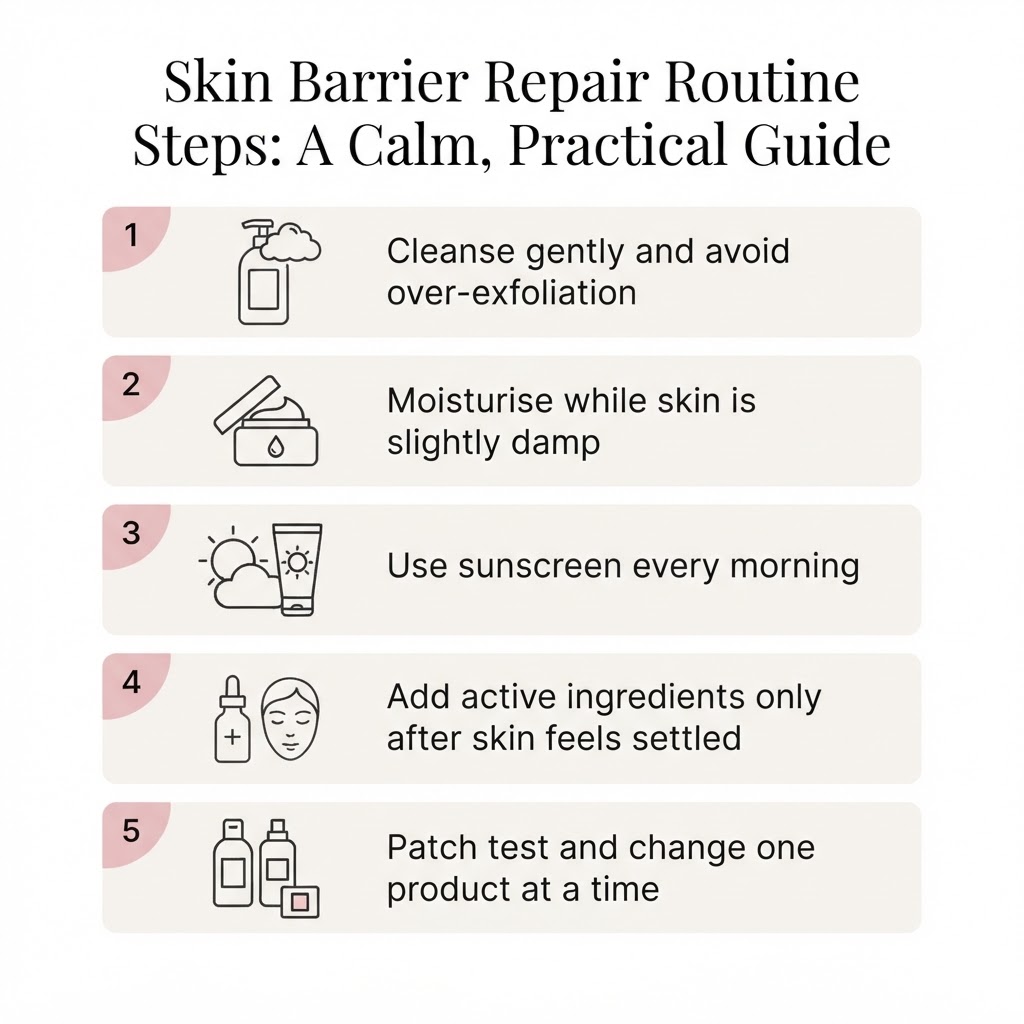
The most useful skin barrier repair routine steps start by reducing avoidable friction. A short reset does not mean abandoning all skincare; it means keeping the essentials and pausing products that repeatedly sting, peel or leave skin feeling raw. There is no universal number of days for a reset. Watch comfort and seek professional advice if symptoms are significant or persistent.
Keep the basic routine deliberately small
- Cleanse gently. In the evening, use a mild cleanser to remove sunscreen, makeup and daily residue. In the morning, a water rinse may be enough for some people; others may prefer a gentle cleanser.
- Moisturise. Choose a comfortable, fragrance-free moisturiser if fragrance tends to irritate you. Apply it to slightly damp skin to help reduce that dry, tight feeling.
- Protect in the morning. Use broad-spectrum sunscreen suited to your skin and follow its label directions. Shade, hats and clothing add useful layers of sun protection.
Pause or reduce non-essential exfoliating acids, scrubs, peel pads and strong retinoids if they cause persistent irritation. If a prescription treatment is part of your routine, ask the prescribing clinician before changing how you use it. The aim is not to label every active ingredient “bad,” but to stop asking stressed skin to tolerate several new challenges at once.
Choose products according to how your skin behaves, not according to a rigid skin-type label. A light lotion may suit someone who feels oily in a humid climate, while a richer cream may feel more comfortable in cold, dry weather. For acne-prone skin, look for a texture that feels wearable and avoid assuming that all moisturisers cause breakouts.
For an overview of the organisms that share the skin surface, see What Is the Skin Microbiome Explained Simply? If you want more practical habits for supporting that ecosystem, our guide to restoring the skin microbiome naturally offers related reading.
A morning and evening routine you can actually repeat
Once the routine is simplified, the next part of skin barrier repair routine steps is making the sequence easy to remember. A dependable routine does not need many layers. Give each product a chance to sit comfortably, and avoid rubbing or scrubbing as you apply it.
Morning: cleanse if needed, moisturise, protect
- Rinse or cleanse gently. Use lukewarm rather than hot water, and pat dry with a clean, soft towel.
- Apply one optional serum. If your skin is comfortable and you already tolerate a simple hydrating serum, apply it according to its directions. During a reset, skipping it is perfectly reasonable.
- Use moisturiser. Spread a comfortable layer over the face and neck. If a serum is part of your routine, moisturiser can follow it.
- Finish with sunscreen. Apply broad-spectrum sunscreen as directed on the label, including exposed areas such as the ears and neck. Reapply as directed, especially during extended outdoor exposure.
Evening: remove the day gently, then replenish
- Remove sunscreen and makeup. Use a gentle cleanser; if you need a first cleanse, choose an option that does not leave skin tight or scrubbed.
- Apply moisturiser while skin is slightly damp. This can help make the application feel more comfortable and reduce the sensation of dryness.
- Keep targeted treatments on hold if they sting. When comfort has improved, reintroduce one product at a time and follow its directions or your clinician’s plan.
The American Academy of Dermatology’s basic skincare guidance likewise emphasizes a simple, gentle approach and sunscreen. The everyday details matter: do not use a rough washcloth on irritated areas, and consider whether hot showers, fragranced laundry products or frequent face washing may be contributing to discomfort.
How to adapt barrier care for acne, eczema, dark marks and ageing
The same broad principles can apply across different concerns, but the details should be personal. Barrier support does not replace acne or eczema care, and no single serum is suitable for everyone. If you have a diagnosed skin condition, recurrent flares or a treatment plan, use this section as general context rather than a substitute for your clinician’s instructions.
Adult acne-prone skin
Acne-prone skin can be oily and dehydrated at the same time. A harsh cleanser or repeated exfoliation may leave the surface uncomfortable without addressing the causes of breakouts. Keep cleansing gentle, choose a moisturiser you can use consistently, and introduce acne ingredients gradually, one at a time.
Prescription retinoids, benzoyl peroxide and other acne therapies can be helpful for appropriate people, but they may also cause dryness or irritation. Follow the directions from your prescriber or product label, and ask a dermatologist how to adjust the schedule if discomfort persists. Avoid applying multiple new acne products in the same week, because it becomes harder to identify what your skin tolerates.
Eczema-prone or highly reactive skin
Eczema-prone skin often needs especially careful product selection. Use a plain moisturiser that feels comfortable, avoid known triggers, and seek a clinician’s advice for an active or recurring rash. Facial eczema can resemble other conditions, and self-directed experimentation with essential oils or potent actives may make irritation harder to manage.
For more focused reading, see our guide to moisturiser and barrier considerations for eczema-prone skin. If your skin is cracked, painful, oozing or rapidly worsening, seek prompt medical advice rather than trying to solve it with a cosmetic routine.
Melanin-rich skin and post-inflammatory marks
Inflammation from acne, irritation or injury can be followed by post-inflammatory hyperpigmentation: areas of excess pigment left after inflammation settles. This can occur in any skin tone and may be more noticeable or longer-lasting in some people with melanin-rich skin. Preventing avoidable irritation and using daily sun protection are practical parts of a considerate routine.
Do not scrub dark marks or use strong lightening products without informed guidance. Once your skin feels settled, a clinician or dermatologist can help you consider suitable options. Our article on building a skincare routine for melanin-rich skin discusses broader routine choices, including the value of gentle, consistent protection.
Ageing skin
Skin can become drier or more easily irritated with age, though individual experience varies. A richer moisturiser may feel more comfortable, while a gradual approach to retinoids or other active ingredients can help reduce unnecessary irritation. Sunscreen and supportive daily habits remain useful at every age.
When skin is comfortable, a targeted serum can be added for a specific goal, such as hydration or uneven tone. A serum is a concentrated step, not a replacement for moisturiser or sunscreen. For dark spots and vitamin C considerations, read Vitamin C Serum for Dark Spots: A Smarter Routine.
Serums, moisturisers and probiotic skincare: what each can contribute
A serum is typically a lightweight product designed to deliver selected ingredients in a thin layer. Depending on its formula, it may focus on hydration, antioxidants or other cosmetic goals. “Serum” describes a product format, not a guarantee of strength, compatibility or results; ingredients and formulation matter.
Moisturisers can combine humectants, emollients and occlusive ingredients. Humectants attract water, emollients soften and smooth, and occlusives help slow water loss by forming a protective film. Many products combine these functions. A suitable moisturiser should feel comfortable enough that you are willing to use it regularly.
Probiotic skincare is a broad marketing and formulation category, and products can differ substantially. Some formulas use probiotic-derived ingredients, such as ferments or lysates, rather than live microorganisms. Research in this area is developing; evidence about one ingredient or formulation should not be assumed to apply to every product.
At Almasi, Velobiotics™ is our approach to probiotic skincare formulation. As with any skincare, assess an individual product by its ingredients, directions and your own experience. If you would like to explore the range, Almasi probiotic skincare is one option to consider after establishing the basic routine.
“The skin microbiome: a focus on its role in the pathogenesis of atopic dermatitis and psoriasis.”
— Biedermann et al., British Journal of Dermatology, 2015
The microbiome is an active research area, but it is important not to overstate what topical products can do. A cosmetic product may support a comfortable routine; it does not diagnose or manage an underlying condition on its own. To explore the evidence and terminology, the peer-reviewed article on the skin microbiome and inflammatory skin disease provides scientific context.
How to reintroduce actives and know when to seek help
When your skin feels more comfortable, reintroduce optional products slowly. The safest pace depends on the ingredient, your skin and any clinical instructions, so there is no universal schedule. A careful method helps you notice whether a product seems to suit you without confusing the result with several other changes.
- Change one thing at a time. Keep the rest of the routine stable while you assess a new product.
- Patch test when appropriate. Follow the product directions and apply a small amount to a discreet area first; a patch test cannot rule out every reaction.
- Start conservatively. Use active ingredients at the frequency and amount recommended by the label or clinician.
- Pause if irritation persists. Burning, swelling, a worsening rash or marked discomfort is a reason to stop the new product and seek advice.
- Keep a brief record. Note what you used, how often and what you noticed, especially if several concerns overlap.
Seek medical advice if symptoms are persistent, recurrent, severe or interfering with sleep and daily life. A clinician can assess whether irritation, allergy, eczema, rosacea, infection or another issue may be involved. Swelling around the eyes or lips, breathing difficulty or a rapidly worsening reaction needs urgent medical attention.
Remember that routine consistency does not mean pushing through pain. Mild, brief sensations can occur with some products, but persistent stinging is not a badge of effectiveness. If sunscreen or a prescribed treatment causes a problem, ask a pharmacist, prescriber or dermatologist about alternatives instead of simply abandoning protection or care.
The simplest first step: make tonight’s routine gentler
For a practical start to skin barrier repair routine steps, choose one change tonight: use a gentle cleanser, skip the product that repeatedly stings, or apply a comfortable moisturiser to slightly damp skin. Keep the rest simple, and give yourself time to observe how your skin responds. A calm routine is not a race to add more ingredients.
If you are ready to explore a considered option for your routine, start with Almasi probiotic skincare and choose products according to your own needs and comfort. Subscribe to the Almasi Journal for thoughtful skincare education and practical routine guidance.