
Your thirties are not a deadline for “fixing” your skin. They are a useful time to build habits that protect its comfort and resilience while addressing changes you actually notice: fine lines, adult breakouts, uneven tone, dryness, or sensitivity. A thoughtful anti ageing routine in your 30s is less about chasing a younger face and more about supporting healthy skin over time.
I’m Dr Chomba Chuma, MD and founder of Almasi. In this guide, I’ll explain what collagen does, how daily habits influence visible ageing, and how to create a routine that respects the skin barrier and microbiome. We’ll also consider acne-prone, eczema-prone, and melanin-rich skin, because there is no single face or skin tone that defines ageing well.
One important note: skincare can support the appearance and function of skin, but it cannot stop ageing or replace medical care. Persistent irritation, painful acne, sudden rashes, or changing spots deserve advice from a qualified healthcare professional.
What changes in skin during your thirties?
Skin is living tissue, not a static surface. Its appearance reflects several processes happening at once: the pace of cell renewal, the strength of the barrier, oil production, inflammation, sun exposure, hormones, sleep, and the structure of the dermis beneath the surface.
The dermis is the deeper layer of skin. It contains collagen, elastin, blood vessels, and other structures that give skin support and flexibility. Collagen is a structural protein: think of it as part of the supportive framework that helps skin feel firm. Elastin helps skin stretch and return toward its usual shape.
From early adulthood onward, collagen production gradually changes, while environmental exposure can contribute to collagen breakdown. These changes are gradual and vary widely. Genetics, cumulative ultraviolet (UV) exposure, smoking, hormones, health, and the way an individual skin barrier responds to daily life all matter.
Visible signs may include fine lines, a less even surface, dryness, or slower recovery after irritation. But not everyone will notice the same signs at the same age. Melanin-rich skin may show visible sun-related ageing differently from lighter skin, while still being affected by UV exposure and inflammation. Skin tone does not make someone immune to environmental damage.
Collagen is not the same as hydration
Dehydration can make fine lines look more noticeable temporarily. Hydration products can improve the look and feel of the surface by attracting or retaining water, but that is different from rebuilding dermal collagen. This distinction helps set realistic expectations: a moisturiser may soften dry-looking lines without changing the deeper support structure.
Likewise, a serum’s “plumping” effect does not necessarily mean it has increased collagen. Product claims should be read carefully, and a comfortable, consistent routine is usually more useful than trying to force fast results with several potent products at once.
Collagen, UV exposure and the habits that matter most
UV radiation is a major environmental contributor to visible skin ageing. UVA can reach deeper into the skin than UVB and is associated with changes to collagen and elastin; UVB is strongly associated with sunburn. Both contribute to skin damage, which is why broad-spectrum sun protection is foundational in an anti ageing routine in your 30s.
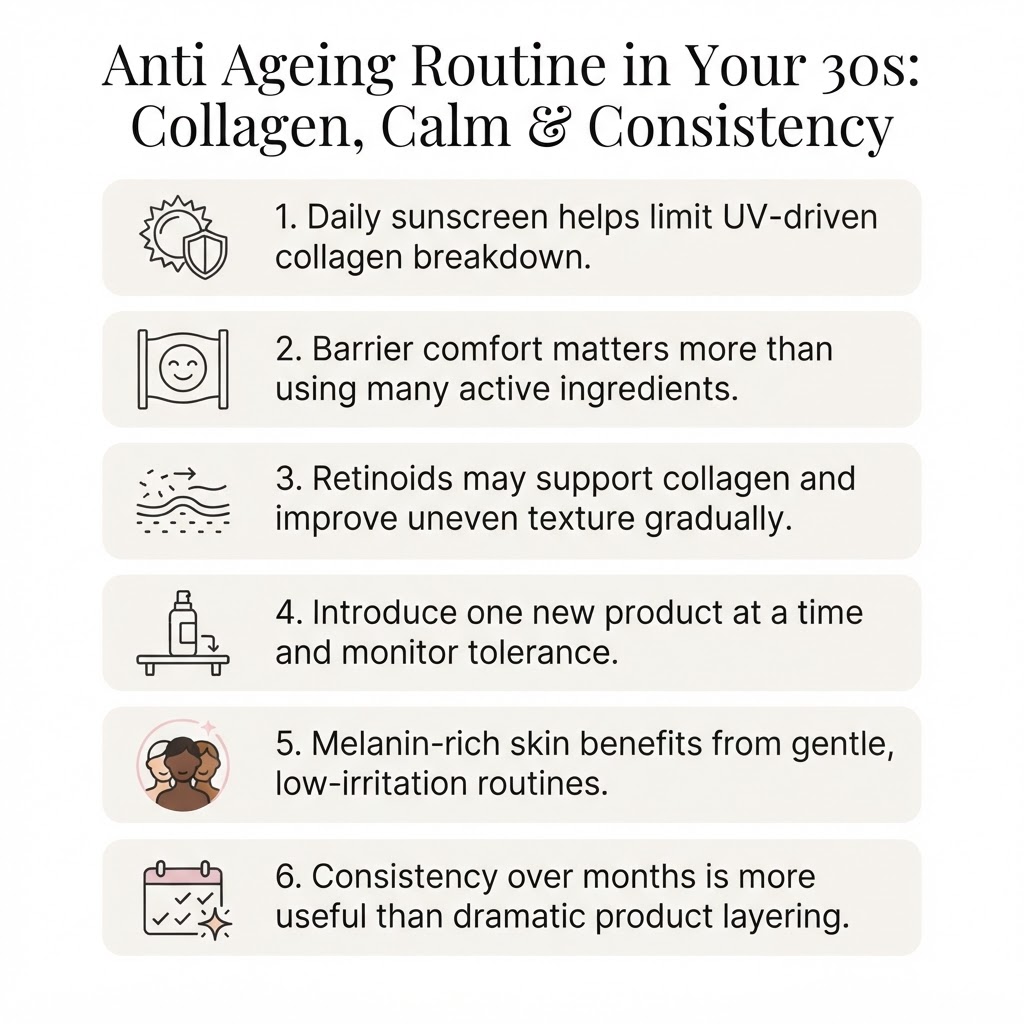
Sunscreen does not erase previous exposure, and it is not a promise that skin will never change. Used properly, broad-spectrum sunscreen reduces the amount of UV reaching the skin. Shade, clothing, and adjusting outdoor plans during intense sun are useful partners. In South Africa, where UV levels can be high, daily protection deserves attention even when the weather feels cool or cloudy.
“The American Academy of Dermatology recommends using a broad-spectrum, water-resistant sunscreen with an SPF of 30 or higher.”
— American Academy of Dermatology, Sunscreen FAQs
Choose a sunscreen you can apply generously and reapply as directed on its label, especially after swimming, sweating, or towel-drying. If sunscreen leaves a visible cast or feels unpleasant, try a different texture or formulation rather than abandoning sun protection altogether. For deeper skin tones, cosmetic elegance matters: an invisible or low-cast finish can make regular use more realistic.
Other daily habits can support overall skin health without turning skincare into a test of perfection:
- Cleanse gently, without scrubbing or using very hot water.
- Use a moisturiser that leaves skin comfortable rather than tight or greasy.
- Avoid smoking and limit repeated unprotected sun exposure.
- Prioritise regular sleep and a varied diet for general health.
- Introduce active ingredients gradually and pause if persistent irritation develops.
These are supportive habits, not guarantees. The point is to reduce avoidable stress on skin and create conditions in which a routine is easy to maintain.
Build a routine around the barrier and skin microbiome
The skin barrier is the outer protective layer that helps limit water loss and keeps many irritants out. It is made from skin cells and the lipids between them, often compared to bricks and mortar. When it is disrupted, skin may feel tight, sting when products are applied, become flaky, or react more readily.
The skin microbiome describes the community of microorganisms that live on the skin. These communities interact with their surroundings and are part of the skin’s ecosystem. A gentle routine aims to avoid unnecessary disruption rather than trying to sterilise skin. To learn more about the subject, see our guide, What Is the Skin Microbiome Explained Simply?
Probiotic skincare is a broad category of products formulated with probiotic-related ingredients, such as ferments or other components associated with microbial processes. Formulations differ, and topical products should not be confused with live cultures or with a medical treatment. If you are curious about what these products can and cannot claim, read What Is Probiotic Skincare and Does It Work?
At Almasi, Velobiotics™ is our approach to probiotic skincare formulation. As with any product, the right choice depends on your own skin, its current condition, and the complete ingredient list. No serum can replace sunscreen, and a microbiome-focused product should not be expected to resolve every concern.
A simple morning and evening framework
You do not need a large shelf of products to care for ageing concerns. Start with the core steps, then add an active ingredient only if it fits your needs and your skin tolerates it.
- Morning: Rinse or use a gentle cleanser if needed, apply a suitable serum, moisturise if your skin needs it, then finish with broad-spectrum sunscreen.
- Evening: Remove sunscreen and makeup with a gentle cleanse, apply one chosen treatment product if appropriate, and moisturise to support comfort.
- Between steps: Give each product a moment to settle, but do not worry about rigid “waiting times” unless the product directions specify them.
For a practical overview of routines designed with melanin-rich skin in mind, visit Skincare Routine for Melanin Rich Skin: A Practical Guide. The best routine is not determined by skin tone alone; it should also reflect sensitivity, oiliness, acne, and personal preferences.
Choose actives carefully: lines, adult acne and uneven tone
Active ingredients are ingredients used to target a particular concern, such as acne, rough texture, or uneven pigmentation. They can be useful, but “more” is not a strategy. Combining several strong actives too quickly can irritate the barrier, and irritation may make some concerns harder to manage.
Retinoids and gradual renewal
Retinoids are vitamin A-related ingredients. Depending on the specific ingredient and formulation, they may support cell turnover and are used in some skincare approaches to fine lines and acne. Prescription retinoids and over-the-counter retinol are not interchangeable, and strength, frequency, and tolerance matter.
If you are considering an over-the-counter retinoid, begin with a low frequency on dry skin and follow the product directions. Add it to a simple routine rather than combining it immediately with exfoliating acids, benzoyl peroxide, or multiple new serums. Mild dryness can occur; ongoing burning, marked redness, swelling, or cracking is a signal to stop and seek professional guidance.
Retinoids are not suitable for everyone. People who are pregnant, trying to become pregnant, or breastfeeding should ask a healthcare professional for advice before using a retinoid. Prescription treatments require the guidance of the clinician who prescribed them.
Adult acne and post-breakout marks
Adult acne can occur alongside dryness or sensitivity. It is not a sign that you are failing to cleanse enough. Repeated scrubbing and harsh astringents can aggravate the skin surface without addressing the factors that contribute to breakouts. A gentle cleanser, non-comedogenic moisturiser, and one evidence-informed acne ingredient may be a more sensible starting point.
Some acne ingredients, including benzoyl peroxide and salicylic acid, can be useful for certain people, but they can also cause dryness or irritation. Introduce one at a time, follow label directions, and ask a clinician or pharmacist whether it suits your skin and health circumstances. Painful, scarring, or persistent acne may benefit from a medical assessment.
After a spot settles, a flat mark can remain. In melanin-rich skin, inflammation may be followed by post-inflammatory hyperpigmentation: extra pigment in an area after irritation or injury. Avoid picking, and keep sun protection consistent. For more on managing marks safely, see How to Fade Dark Spots on Melanin Rich Skin Safely.
Serums and moisturisers: assign each a job
A serum is usually a lighter product designed to deliver selected ingredients; a moisturiser is formulated to support softness and reduce water loss. Neither label guarantees a particular result. Read the full ingredient list, consider fragrance and known sensitivities, and choose a texture you are likely to use.
If you want to explore a microbiome-focused product, consider an Almasi probiotic serum as one possible step in a basic routine. Check the product directions and ingredient information, patch test if you are reactive, and do not apply it to broken or actively irritated skin unless a healthcare professional advises you to do so.
People prone to eczema may need a particularly simple routine and a moisturiser they already know they tolerate. Eczema is a medical condition, and cosmetic products are not a substitute for an individual care plan. For background on barrier-conscious product choices, read Probiotic Moisturiser for Eczema-Prone Skin: Barrier Guide.
Adapt the routine to your skin tone, sensitivity and season
Skin tone is one part of the picture, but it does not tell the whole story about sensitivity or product needs. Melanin-rich skin can experience visible pigmentation changes after inflammation, so reducing irritation is particularly relevant when introducing actives. This does not mean avoiding all active ingredients; it means using them with care and a clear purpose.
If your skin is sensitive, begin with cleanser, moisturiser, and sunscreen for a couple of weeks before adding a new active. If you have oily or acne-prone skin, a light moisturiser may feel more comfortable than a rich cream, but skipping moisturiser altogether can leave some people feeling dry or tight. If your skin is dry, a richer, fragrance-free moisturiser may be preferable.
Season and environment may also change what feels comfortable. Wind, indoor heating, air conditioning, long outdoor days, and frequent swimming can all affect how skin feels. Keep the routine flexible: use fewer potentially irritating steps when skin is unsettled, and return to your usual products only once comfort has improved.
Patch testing can help you notice a reaction before applying a new product across your face. Apply a small amount to a discreet area according to the product directions, and observe for signs such as persistent redness, itching, swelling, or discomfort. A patch test cannot predict every reaction, but it is a practical precaution.
“The use of topical retinoids in the treatment of photoaging: a review of the literature.”
— Mukherjee et al., Clinical Interventions in Aging, 2006
Research reviews describe retinoids as an area of study for photoaged skin, but findings for one ingredient or formulation should not be assumed to apply to every product. For a peer-reviewed overview, see the review on topical retinoids and photoaging indexed in PubMed. For practical sun protection advice, consult the American Academy of Dermatology’s sunscreen guidance.
How to tell whether your routine is working
Skin changes slowly, so assess a routine over weeks rather than judging it after one application. The first signs of a suitable routine may be practical: less tightness after washing, fewer episodes of stinging, a moisturiser that sits comfortably, or more consistent sunscreen use. Changes in acne, texture, and pigmentation often need more time and can fluctuate.
Try taking a baseline photograph in natural light and repeating it monthly, using similar lighting and no filters. Keep brief notes about new products and reactions. This can help separate a real pattern from day-to-day variation, hormonal changes, or changes in lighting.
For an anti ageing routine in your 30s, consistency does not mean continuing a product that causes persistent discomfort. A product is not “working” if you are constantly irritated or avoiding it because it feels unpleasant. Adjust the routine, and seek professional input when symptoms are significant or ongoing.
Use this short checklist when reviewing your routine:
- Is my cleanser leaving skin comfortable, not stripped?
- Do I moisturise when my skin feels dry or tight?
- Can I apply enough sunscreen and reapply when needed?
- Have I introduced only one new active at a time?
- Am I tracking irritation, breakouts, or pigmentation rather than guessing?
- Do I need a clinician’s advice for a persistent or painful concern?
Remember that skincare outcomes are individual. If you have a history of eczema, allergies, or reactions to cosmetics, a dermatologist or other qualified healthcare professional can help tailor advice. For a changing mole or spot, do not rely on a cosmetic routine; arrange an appropriate medical assessment.
Your simplest first step: make sunscreen consistent
If you do only one thing to begin your anti ageing routine in your 30s, make broad-spectrum sunscreen a daily habit. Choose a formula you enjoy wearing, apply it as directed, and pair it with shade or protective clothing during extended time outdoors. When that step feels automatic, consider adding one well-chosen serum or moisturiser to address a specific need. Explore the Almasi skincare collection to find a product type that fits your routine.
Subscribe to the Almasi Journal for thoughtful, science-aware guidance on skin, ingredients, and everyday routines.