
When skin suddenly feels tight after washing, stings at the touch of a familiar serum, or looks rough and uneven, it is natural to search for the best moisturiser for damaged skin barrier. The aim is not to find a miracle product. It is to choose a moisturiser that reduces water loss, feels comfortable on your skin, and fits a routine that gives the barrier room to recover.
I’m Dr. Chomba Chuma, MD, founder of Almasi. In this guide, I’ll explain what moisturisers can and cannot do, how to choose one for acne-prone or eczema-prone skin, and where probiotic skincare may fit. We will also cover dark marks, ageing, and practical considerations for melanin-rich skin.
“Damaged” is everyday language, not a diagnosis. Skin discomfort can have many causes, including overuse of active ingredients, dry weather, eczema, allergy, infection, or another skin condition. If symptoms are severe or persistent, a healthcare professional can help identify the cause rather than leaving you to experiment.
What a compromised barrier feels like—and what it means
The skin barrier is the outermost working layer of the skin. Its cells sit in a matrix of fats, including ceramides, cholesterol, and fatty acids. You can picture the cells as bricks and the surrounding lipids as mortar: together, they limit excess water loss and help keep irritants out.
When this system is under strain, the skin may lose water more readily and feel less comfortable. A moisturiser supports the surface environment, but it does not identify or resolve every underlying cause. Barrier symptoms can overlap with eczema, contact dermatitis, rosacea, acne-related irritation, and other conditions.
- Possible signs of irritation: unusual tightness, flaking, rough patches, or stinging when applying products that were previously comfortable.
- Possible signs of inflammation: persistent redness, itching, swelling, or tenderness. On darker skin, inflammation may appear brown, purple, grey, or darker than the surrounding skin rather than bright red.
- Reasons to seek advice: cracking, weeping, crusting, significant pain, swelling near the eyes, rapidly worsening symptoms, or a rash that does not settle.
A short period of sensitivity after a new product does not automatically mean the barrier is damaged. A fragrance allergy or irritation may look similar, and continuing to apply the suspected trigger can make things worse. Stop a product that causes a clear reaction and seek clinical guidance if symptoms are significant.
For a deeper practical overview of product order and pacing, see Almasi’s skin barrier repair routine guide. For a closer look at the community of microorganisms on skin, explore what the skin microbiome is.
How to choose the best moisturiser for damaged skin barrier
The best moisturiser for damaged skin barrier is usually one that is simple, well tolerated, and appropriate for your skin’s oiliness and climate. Price, texture, and marketing claims do not reliably predict how your skin will respond. Look for a product you can use consistently without burning or adding unnecessary steps.
Understand the three useful moisturiser roles
Many formulas combine ingredients from more than one group. Knowing the basic roles can make an ingredient list less mysterious.
- Humectants, such as glycerin and hyaluronic acid, attract and hold water in the outer layers of skin. They can improve the feel of dryness, especially when used with a cream or lotion that helps limit water loss.
- Emollients, such as certain fatty alcohols and plant-derived oils, soften rough areas and help smooth the skin surface.
- Occlusives, such as petrolatum or dimethicone, form a surface layer that slows water evaporation. A richer occlusive texture can be useful for very dry patches, but may feel too heavy on some faces.
Barrier-supportive formulas may also include lipids such as ceramides. There is no single ingredient ratio or product that suits everyone, and the full formula matters: a helpful ingredient can still be paired with something that irritates an individual.
Read the label with your skin in mind
If your skin is reactive, start with a fragrance-free product and avoid introducing several new ingredients at once. “Natural” is not a synonym for non-irritating; botanical extracts and essential oils can also trigger sensitivity. If you have reacted to a known ingredient, check the full ingredient list rather than relying on broad claims such as “gentle.”
- For an oily or acne-prone face, consider a lighter lotion or gel-cream and apply a small amount first.
- For dry, flaky areas, a richer cream may feel more protective; a thin layer of an occlusive over moisturiser can be considered for selected patches.
- For eczema-prone skin, choose a fragrance-free formula and follow advice from your clinician, especially during a flare.
- For combination skin, use a lighter layer across the face and add more only where needed.
“Non-comedogenic” means a product is formulated to be less likely to clog pores; it is not a guarantee that no individual will break out. If a product seems to worsen acne, pause it and review the whole routine. Do not assume that every new blemish is a purging phase.
“Moisturizers can help maintain skin hydration and improve the skin barrier.”
— American Academy of Dermatology Association, Skin care tips for people with acne
The American Academy of Dermatology offers practical advice on choosing moisturiser when you have acne. Its guidance is a useful reminder that acne-prone skin can still benefit from moisturising, particularly when acne products make skin dry or irritated.
Probiotic skincare, the microbiome, and realistic expectations
The skin microbiome is the community of microorganisms that lives on the skin, together with its surrounding environment. Its balance varies by person and by body site. Cleansing, climate, age, hormones, medicines, and skin conditions all influence what the skin experiences.
Probiotic skincare is a broad term used for topical products featuring ingredients associated with beneficial microbes, or ingredients designed to support a balanced skin environment. In a cosmetic formula, these may be lysates, ferments, or other postbiotic materials rather than live probiotic organisms. Formulas and evidence differ, so the word “probiotic” alone cannot tell you how a product will perform.
At Almasi, Velobiotics™ is our approach to probiotic skincare. It is part of a carefully designed routine, not a replacement for a plain moisturiser, sunscreen, or medical care. A product may support comfort and a well-cared-for skin surface, but it should not be described as restoring a microbiome with certainty or as a treatment for eczema, acne, or another disease.
Research into microbiome-based skin care is active, but the science is still developing. Studies may examine specific strains, ingredients, or laboratory conditions that do not directly predict the effect of a finished product on every person. For an overview of the research landscape, see this peer-reviewed review indexed on PubMed on the skin microbiome and dermatologic conditions.
If you are curious about the role of topical products, you can read our explanation of what probiotic skincare is and what the evidence can tell us. The key consumer question is straightforward: does this particular product feel comfortable, suit your skin, and fit a routine that avoids repeated irritation?
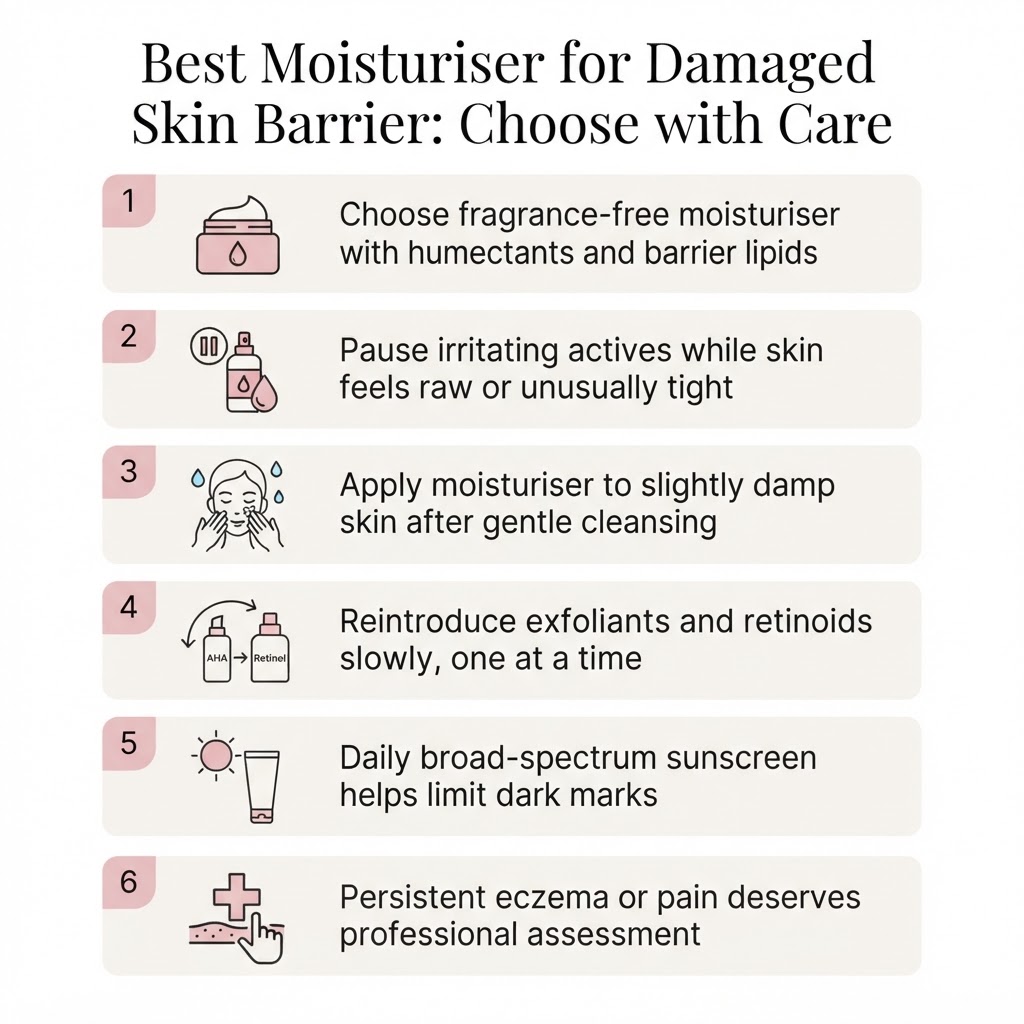
Build a low-irritation routine around your moisturiser
When skin is reactive, a long routine can make it harder to identify the source of discomfort. Simplifying is not a step backward; it is a way to reduce variables. The best moisturiser for damaged skin barrier works best as one part of a steady routine, rather than as a reason to layer more actives over uncomfortable skin.
Keep the basics predictable
- Cleanse gently. Use lukewarm water and a mild cleanser when you need one. Avoid scrubbing, cleansing brushes, and very hot water while skin is unsettled.
- Apply moisturiser soon after cleansing. Pat rather than rub, leaving the skin slightly damp if that feels comfortable.
- Use sunscreen in the morning. Choose broad-spectrum sun protection that you tolerate and reapply according to its label and your exposure.
- Pause optional irritants. Temporarily set aside exfoliating acids, retinoids, strong vitamin C formulas, fragranced products, and harsh acne treatments if they sting or worsen dryness.
You do not need to discontinue a prescribed medicine without consulting the person who prescribed it. If a prescription product seems to trigger irritation, contact your clinician or pharmacist for advice about frequency, placement, or alternatives.
Once skin feels comfortable and stable, reintroduce only one active ingredient at a time. Use it less often than before at first, and leave enough time to notice whether irritation develops. There is no universal waiting period; the right pace depends on the product, your skin, and any clinical advice.
For people interested in adding a probiotic step, Almasi probiotic serum can be considered as an optional cosmetic layer, provided its ingredient list suits you and your skin is not currently reacting. Patch test according to the product directions, introduce it alone, and stop if you develop persistent burning, swelling, or a rash.
“There is no one-size-fits-all approach to skin care.”
— American Academy of Dermatology Association, Skin care on a budget
That principle matters especially when the skin barrier is unsettled. A consistent, uncomplicated routine you tolerate is more useful than a shelf of products selected by trend.
Adapting barrier care for acne, eczema, dark marks, and ageing
Acne-prone adult skin
Acne and dryness can occur together. Some acne treatments reduce oil or speed skin-cell turnover, and irritation may follow if they are introduced too frequently or combined with other strong products. A light moisturiser can help support comfort without requiring you to give up acne care altogether.
Keep acne routines measured. Avoid picking, abrasive scrubs, and starting several acne ingredients in the same week. If breakouts are painful, scarring, or affecting your wellbeing, a dermatologist or other qualified clinician can help you discuss suitable options.
Eczema-prone skin
Eczema-prone skin can be especially sensitive to fragrance and environmental triggers. Moisturising is commonly part of eczema skin care, but over-the-counter cosmetics are not a substitute for an individual management plan. If a product burns, worsens itching, or appears to trigger a rash, stop using it and seek advice.
People with frequent flares, broken skin, or uncertainty about which products are suitable should speak with a healthcare professional. For a focused discussion of product selection for eczema-prone skin, read our guide to moisturisers and eczema-prone skin.
Hyperpigmentation and melanin-rich skin
Inflammation can leave post-inflammatory hyperpigmentation: a darker mark that remains after a spot, rash, or other irritation settles. It can affect all skin tones, and is often more noticeable or longer-lasting in melanin-rich skin. Avoiding repeated irritation is therefore an important part of caring for uneven tone.
Do not try to fade a dark mark by scrubbing or applying multiple strong actives to sore skin. Daily sun protection helps limit the darkening of existing marks and supports an even-toned routine. For tailored discussion of tone, sensitivity, and sunscreen choices, see our routine guide for melanin-rich skin.
Redness can be less obvious on darker complexions. Pay attention to warmth, tenderness, itching, swelling, or a new patch that looks darker, purple, or grey compared with your usual skin. If a mark is changing, painful, or unexplained, seek a professional assessment rather than assuming it is pigmentation.
Ageing skin
Skin can become drier with age, and some people find that a previously comfortable routine becomes too stripping. A moisturiser can improve the feel of dryness and soften the appearance of fine surface lines caused by dehydration; it does not replace sun protection or reverse every age-related change.
When considering retinoids or other ingredients often used in ageing routines, begin only when the skin is comfortable. Introduce one product at a time and seek clinician guidance if you have eczema, are pregnant or breastfeeding, or are unsure whether an ingredient is appropriate for you.
When to seek advice—and how to make a confident choice
Even a thoughtful product choice may not be enough if a medical condition is driving the symptoms. Book a professional assessment if discomfort persists, repeatedly returns, spreads, interrupts sleep, or is accompanied by cracks, weeping, crusting, or notable swelling. Seek urgent care for a severe reaction, rapidly spreading swelling, or difficulty breathing.
For day-to-day shopping, use a small checklist rather than trying to decode every marketing claim:
- Does the formula match how dry or oily your skin feels?
- Is it fragrance-free if you are sensitive or eczema-prone?
- Can you use it without persistent stinging or worsening discomfort?
- Does it fit your budget and a routine you can maintain?
- Are the brand’s claims specific and realistic rather than promising a cure?
Try a new product on a small area first, following the label’s directions. A patch test cannot rule out every future reaction, but it may reveal obvious irritation before you apply a product widely. Keep notes about what you introduced and when, especially if your skin is reactive.
There is no single best moisturiser for damaged skin barrier for every face, complexion, climate, or diagnosis. The best choice for you is a well-tolerated formula that supports hydration, fits your needs, and does not demand a complicated routine. If symptoms suggest a condition such as eczema or contact dermatitis, professional guidance matters more than finding a more elaborate cosmetic.
Your simplest first step: choose one gentle moisturiser
Start by selecting one fragrance-free moisturiser that matches your skin’s dryness and feels comfortable, then use it consistently alongside gentle cleansing and daytime sun protection. Explore the Almasi skincare collection if you would like to consider a probiotic serum or moisturiser as part of that simple routine.
Subscribe to the Almasi Journal for thoughtful, evidence-aware guidance on skin science, routines, and care for every skin tone.