
If you are searching for where to buy almasi skincare, you may already know what you want: a considered routine that supports the skin barrier without asking you to layer a dozen products. But choosing a place to shop is only one part of the decision. It also helps to know what probiotic skincare can realistically contribute, how to select a serum or moisturiser, and how to introduce products when your skin is acne-prone, sensitive, or prone to uneven tone.
Almasi is a South African skincare brand built around Velobiotics™ technology. Its approach draws on interest in the skin microbiome: the community of microorganisms that naturally live on the skin and interact with its local environment. This is not a promise to change your skin overnight. It is a way to think about formulas, daily habits, and product choices with skin comfort and consistency in mind.
This guide explains how to shop thoughtfully, build a simple routine, and understand the needs that can arise across different skin tones and life stages. It is educational information, not individual medical advice. Persistent, painful, or rapidly changing skin concerns deserve guidance from a dermatologist or another qualified healthcare professional.
Where to buy Almasi skincare and shop with confidence
The simplest way to check current Almasi product availability is to visit the brand’s official Almasi skincare collection. There you can review the products currently listed, read the product descriptions, and confirm the details relevant to your order. Availability, delivery options, and product information can change, so check the store directly before purchasing.
When people ask where to buy almasi skincare, they are often also asking how to choose the right first product. Start with a skin need rather than the most ambitious routine you can imagine. A moisturiser may be the more useful first purchase if your face feels tight after cleansing; a serum may be appealing if you want to add a targeted step while keeping the rest of your routine familiar.
- For a minimal start: choose a gentle cleanser, a moisturiser that feels comfortable, and daytime sun protection.
- For a serum step: select one product that fits your routine and introduce it gradually.
- For sensitive or reactive skin: read the product information, patch test, and avoid starting several unfamiliar formulas together.
- For a specific skin condition: treat skincare as supportive care, not a replacement for a clinician’s advice.
Buying from the official collection also makes it easier to compare product categories and current descriptions in one place. Before checkout, confirm the product name, size, ingredients, shipping information, and any instructions published by the brand. If you are unsure whether a formula is suitable for you, ask the brand for product details and consult a healthcare professional when a medical concern is involved.
For more background on the brand’s product categories and how readers may think about a routine, see Almasi Probiotic Skincare Reviews: Find Your Best Routine. This guide takes a different angle: it focuses on shopping decisions and on fitting products into a routine without overcomplicating it.
What the skin microbiome means for everyday skincare
The skin microbiome is the collection of microorganisms—including bacteria, fungi, and other microscopic life—found on the skin’s surface. These communities exist alongside the skin barrier, the outer protective system that helps limit water loss and environmental irritation. Their balance varies by body site, age, environment, and individual skin characteristics; “healthy microbiome” does not mean that every person should have identical microbes.
Probiotic skincare is a broad label, and formulas do not all work in the same way. A product may contain live microorganisms, non-living microbial material, or ingredients designed to support a comfortable skin environment. Read the specific formula description rather than assuming that the word “probiotic” means a cream contains live bacteria or produces a particular result.
Research into the relationship between skin microbes and skin health is developing. Scientists investigate how microbial communities interact with immune responses, skin chemistry, and barrier function. That research is valuable, but it does not mean every cosmetic product has been shown to change the microbiome in a clinically meaningful way or to resolve a skin condition.
“The skin microbiome is an important part of the skin ecosystem, but its role is complex and still being studied.”
— Byrd, Belkaid and Segre, Nature Reviews Microbiology, 2018
The review The human skin microbiome describes how microbial communities relate to the skin and why they vary across people and locations. A practical takeaway is modest: gentle, consistent care can be more useful than repeatedly stripping the skin or changing products in response to every small fluctuation.
That does not mean you need to avoid cleansing or active ingredients. It means choosing products in context. A cleanser that leaves your face uncomfortably tight may be too much for your routine, while a well-tolerated serum can be one step among several—not a substitute for moisturiser, sun protection, or medical care when needed.
Choosing a serum and moisturiser for your skin’s needs
Serums and moisturisers have different jobs in a routine. A serum is usually a lighter leave-on product designed to deliver a particular blend of ingredients, while a moisturiser is generally used to improve skin comfort and reduce moisture loss. Those categories overlap, and a product’s texture alone does not tell you exactly how it will behave on your skin.
Start with the concern you can describe
Use ordinary observations to guide your first choice: does your skin feel dry, look shiny by midday, sting when you apply familiar products, or develop recurring clogged pores? These clues are not a diagnosis, but they can help you identify what you want a product to do in your daily routine. If a concern is severe, persistent, or affecting your quality of life, seek professional assessment rather than relying on product shopping alone.
- For discomfort or dryness: consider prioritising a moisturiser that feels pleasant and can be used consistently.
- For a targeted step: consider a serum if you can add it without abandoning the basics that already suit you.
- For acne-prone adult skin: avoid assuming that all breakouts come from poor hygiene or that a microbiome product is an acne medicine.
- For eczema-prone skin: keep routines simple and follow your clinician’s plan; a cosmetic product is not a substitute for prescribed care.
For example, imagine a person with combination skin who gets an oily forehead but feels tight around the cheeks. They could keep a gentle cleanser, apply a serum according to its directions, and use a comfortable moisturiser in an amount suited to each area. The goal is a routine they can repeat—not to make every part of the face feel identically matte or heavily coated.
If you want to explore a lightweight leave-on step, compare the current description of the Almasi probiotic serum with your preferences and existing routine. If you are looking for a moisturising step, review the collection for the current product information and choose according to texture, use directions, and personal tolerance.
Think about pigmentation and skin tone
Post-inflammatory hyperpigmentation is a dark mark that can remain after inflammation, such as a blemish or irritation, settles. It can be especially noticeable on melanin-rich skin, though it can affect any skin tone. The first practical aim is to reduce avoidable irritation and protect skin from ultraviolet exposure, which can contribute to marks becoming more persistent.
People with darker skin tones are not immune to sun damage, and sunscreen can be part of a routine across the full range of complexions. Choose sun protection that you find comfortable enough to use regularly. For a deeper discussion of gentle approaches to uneven tone, read How to Fade Dark Spots on Melanin Rich Skin Safely.
Skincare can also be shaped by age. Skin may feel drier or less resilient over time, while adult acne can continue or begin later in life. A thoughtful routine can adapt to these changes without labelling normal variation as a flaw or promising that one serum will reverse ageing.
Build a calm routine for adult acne, sensitivity, and changing skin
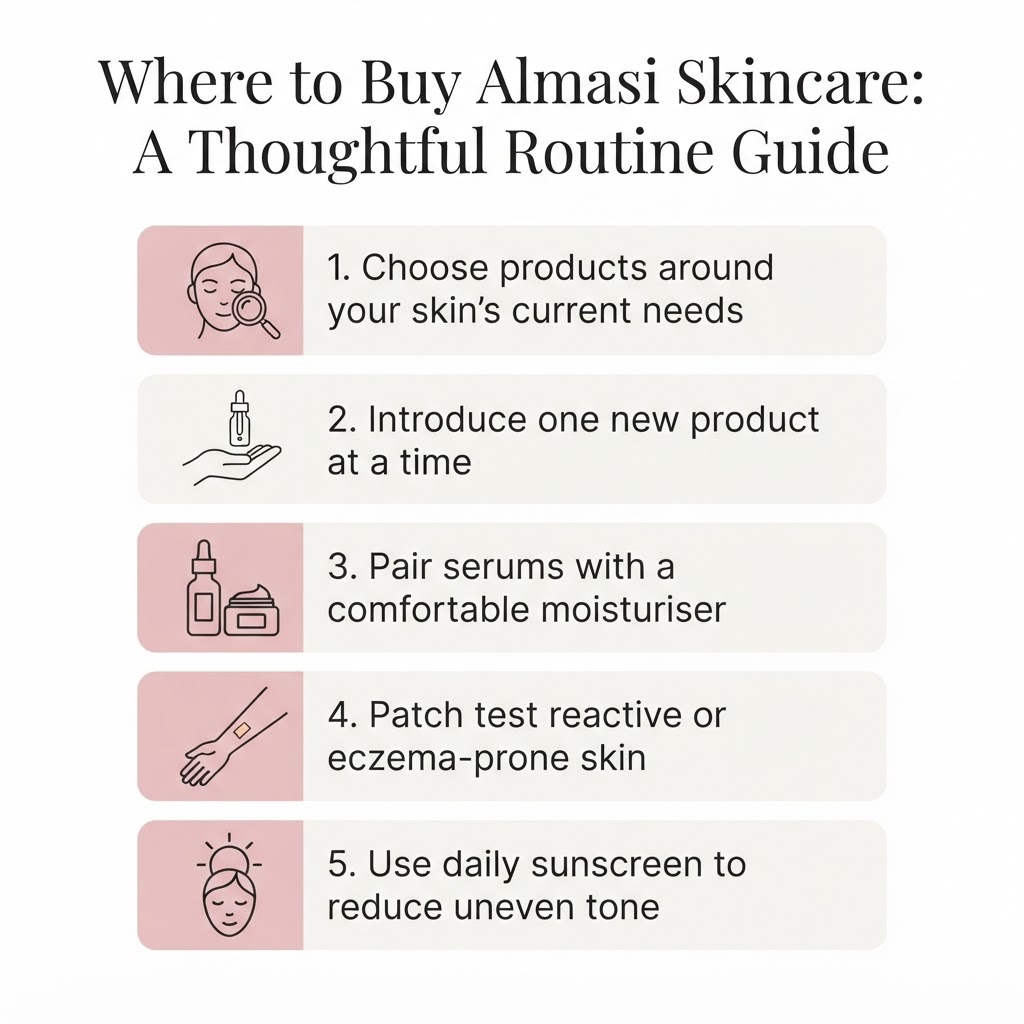
A simple routine is easier to evaluate. When you introduce several new products at once, it becomes difficult to tell which one feels comfortable and which one may be contributing to irritation. Introduce one new product at a time, follow its directions, and give yourself a chance to notice how your skin responds.
A practical morning routine
- Cleanse gently if needed. Some people prefer a rinse with water in the morning; others prefer a mild cleanser. Choose what leaves your skin comfortable.
- Apply one serum, if it suits your plan. Follow the product’s directions rather than using more than recommended.
- Moisturise as needed. Use a texture you are willing to apply consistently.
- Finish with broad-spectrum sun protection. Follow the label directions and reapply as appropriate for your activity and exposure.
A practical evening routine
- Remove sunscreen and makeup with a cleansing approach your skin tolerates.
- Apply your chosen leave-on product as directed; do not add multiple new active products on the same night.
- Use moisturiser if your skin benefits from it or feels dry after cleansing.
- Keep prescribed treatments in the routine exactly as advised by your clinician.
Adult acne can be influenced by several factors, including hormones, genetics, medications, and the behaviour of oil glands and hair follicles. A cosmetic routine can support comfort, but it should not be presented as a guaranteed way to clear acne. The American Academy of Dermatology offers evidence-informed guidance on skin care habits for acne-prone skin, including advice to use gentle care and avoid unnecessary irritation.
For eczema-prone skin, the priority is often maintaining a routine that does not aggravate dryness or sensitivity and following medical advice for flare management. Fragrance, cleansing habits, weather, and personal triggers may all be relevant, but individual responses differ. Our related Probiotic Moisturiser for Eczema-Prone Skin: Barrier Guide discusses this topic in more detail.
“People with acne should use gentle skin care products.”
— American Academy of Dermatology, Acne: Tips for managing, current guidance
That advice is useful because harsh scrubbing can make the skin feel more irritated without addressing the multiple processes involved in acne. If you have painful nodules, scarring, sudden worsening, or persistent breakouts, a dermatologist can discuss options better supported for acne than cosmetic products alone.
How to introduce products and interpret your skin’s response
A patch test is a cautious way to check for an obvious reaction before applying a new product broadly. Follow the product’s instructions; if none are given, apply a small amount to a limited area and observe for irritation over time. A home patch test cannot guarantee that you will never react, and it does not replace medical allergy testing.
Make one change at a time. If your routine already includes prescription products, acids, retinoids, or other active ingredients, ask your prescriber or pharmacist how a new cosmetic product fits. The issue is not that all combinations are inherently unsafe; it is that your personal plan, skin tolerance, and product instructions matter.
- Keep notes: record when you started a product and any changes in comfort, dryness, or breakouts.
- Use the stated amount: more product does not necessarily mean better results and may make a formula uncomfortable.
- Pause if irritation appears: discontinue a suspected product and seek professional advice if the reaction is significant or persistent.
- Be patient with cosmetic routines: look for gradual changes in comfort and consistency rather than expecting an overnight transformation.
There is an important difference between a short-lived adjustment and a reaction that should not be ignored. Burning, marked swelling, blistering, severe itching, or rapidly spreading redness warrants stopping the product and seeking appropriate medical advice. People with known allergies or a history of strong reactions should be particularly careful and consult a clinician if uncertain.
Research on the microbiome can help inform future product development, but consumers should be cautious about broad promises. A cosmetic product can be part of a supportive routine; it cannot be assumed to restore every aspect of the skin ecosystem or address the underlying cause of each concern. The review in Nature Reviews Microbiology provides useful scientific context without turning an emerging field into a simple product claim.
When comparing products, look for clear directions and a complete ingredient list. Consider whether the formula fits your tolerance, how it layers with other products, and whether you can afford to use it as intended. These everyday checks are more useful than choosing based on a single trend or on the belief that a higher price guarantees better results.
Where to buy Almasi skincare: the simplest next step
If you are still deciding where to buy almasi skincare, begin with the official collection and choose just one product that fits a clear need in your current routine. Review its directions and product details, then introduce it gradually while keeping the rest of your routine steady. That is a more informative first step than buying several products at once.
Explore the current Almasi skincare collection to compare available serums, moisturisers, and other products. Shop according to your preferences, tolerance, and the guidance of your healthcare professional where relevant; no cosmetic product can promise the same experience for everyone.
Subscribe to the Almasi Journal for thoughtful skincare education, practical routine guidance, and new articles on skin and the microbiome.