
When people search for almasi probiotic skincare reviews, they are often looking for more than a product verdict. They want to know whether microbiome-aware skincare makes sense for their particular skin: adult acne that arrived after adolescence, eczema-prone sensitivity, uneven pigmentation, early lines, or the changing needs of melanin-rich skin.
I am Dr. Chomba Chuma, MD and founder of Almasi. My approach begins with a practical principle: healthy-looking skin is not created by an aggressive routine. It is supported by a calm surface environment, a functioning barrier and products that respect the biology of the skin rather than constantly challenging it.
This guide explains how to assess probiotic skincare, how Velobiotics™ fits into a routine, and how to choose between a serum, moisturiser and cleanser. It is educational rather than diagnostic; persistent, painful or rapidly changing skin concerns deserve advice from a qualified healthcare professional.
What probiotic skincare is designed to support
Your skin microbiome is the community of microorganisms living on the skin’s surface. It includes bacteria, fungi and other microscopic organisms that interact with one another and with your skin cells. The microbiome is not automatically harmful or beneficial: balance, diversity and the condition of the surrounding environment matter.
Probiotic skincare uses microorganisms, microbial ingredients or fermentation-derived components with the intention of supporting a favourable surface environment. In many formulas, the organisms are not living probiotics in the same way as those found in yoghurt or supplements. The label may instead refer to lysates, ferments, postbiotics or other microbiome-conscious ingredients.
“Postbiotic” generally describes preparations made from microorganisms or their components that may have a biological function. “Prebiotic” describes a substance intended to nourish selected microorganisms. “Probiotic” has a more specific scientific meaning, so consumers should look beyond the front of the package and examine the complete ingredient list and product claims.
- Microbiome support: formulas aim to work alongside the skin’s existing ecosystem.
- Barrier comfort: moisturising ingredients can reduce the feeling of tightness and dryness.
- Lower routine stress: a gentle approach may be useful when exfoliation or cleansing has become excessive.
- Better consistency: comfortable products are more likely to be used regularly.
Research remains active, and outcomes depend on the exact ingredient, concentration, vehicle and individual skin. A thoughtful review therefore asks, “Does this formula suit my skin and routine?” rather than expecting one product to perform identically for everyone.
How Velobiotics™ fits into a skin-first routine
Velobiotics™ is Almasi’s technology platform for creating microbiome-conscious topical formulas. The purpose is not to sterilise the skin or replace its natural biology. It is to develop elegant products that can sit within a routine focused on hydration, barrier support and long-term tolerability.
A useful way to understand the approach is to think of the skin as an ecosystem. Water availability, acidity, sebum, sweat, cleansing, climate and cosmetics all influence that ecosystem. If a routine repeatedly causes stinging, scaling or tightness, the visible issue may not be a lack of stronger actives; it may be a routine that is asking too much of the skin.
What to look for when reading reviews
Online reviews can reveal texture, absorption, scent, packaging and how a product fits real life. They cannot establish whether a formula is right for your skin, and a single review cannot confirm an ingredient’s effectiveness. The most useful almasi probiotic skincare reviews describe the reviewer’s baseline, routine, climate and timeframe.
- Was the reviewer dry, oily, combination or sensitive before starting?
- Did they introduce one new product or several at once?
- Did they describe comfort, hydration and texture separately from blemishes or pigmentation?
- Did they use daily sunscreen while assessing uneven tone?
- Did they allow enough time to judge routine compatibility?
For additional context, see this science-led guide to skin barrier repair. It explains why a supportive baseline can make an advanced routine easier to tolerate.
“The skin microbiome is increasingly recognised as an important component of skin health, but translating microbiome science into consistent cosmetic outcomes requires careful formulation and well-designed studies.”
— Belkaid and Segre, Nature Reviews Immunology, 2014
Choosing a routine for your skin’s actual behaviour
Skin type is a useful starting point, but skin behaviour is often more informative. Ask what your skin does during the day, after cleansing, in winter, during stressful periods or when you use active ingredients. Your answer can guide the order and frequency of products more effectively than a label such as “combination” or “sensitive”.
Adult acne-prone skin
Adult acne-prone skin can be oily in one area and dehydrated in another. It may also be reactive because of frequent cleansing, spot treatments or exfoliation. A microbiome-conscious routine should not be interpreted as permission to ignore established acne care; instead, it can provide a gentle hydrating foundation around products recommended by a dermatologist.
- Cleanse gently, especially in the morning if your skin is not oily.
- Use a lightweight serum on clean, slightly damp skin.
- Follow with a non-heavy moisturiser where needed.
- Avoid introducing acids, retinoids and multiple new serums in the same week.
- Use broad-spectrum sunscreen every morning.
If blemishes are painful, persistent or leaving marks, professional guidance is worthwhile. Picking and repeated irritation can prolong visible redness or post-inflammatory hyperpigmentation.
Eczema-prone and reactive skin
Eczema-prone skin may feel itchy, dry, rough or easily irritated. It can be particularly sensitive to fragrance, harsh surfactants, abrupt weather changes and too many active ingredients. Choose a short routine, patch test new products and stop if a product causes significant burning, swelling or worsening symptoms.
Our guide to probiotic moisturiser for eczema-prone skin covers selection and application in greater detail. A skincare product should support comfort, but it should not replace medical care for an active flare or suspected infection.
Hyperpigmentation and melanin-rich skin
Melanin-rich skin is not inherently more sensitive, but inflammation can sometimes leave more noticeable dark marks. This is why a low-irritation routine matters when addressing uneven tone. Gentle cleansing, moisturising and daily sun protection create the conditions in which tone-focused products can be used more consistently.
Do not judge progress only by the first few days. Photographing the same area in similar lighting every four weeks is more useful than comparing your skin in different mirrors. A serum may support hydration and radiance, but pigment changes are influenced by sun exposure, inflammation, hormones and the underlying cause of the discolouration.
Ageing and changing skin
Ageing skin may produce less oil, recover more slowly from irritation and show dehydration lines more readily. A probiotic serum can be used as a hydration layer, while a moisturiser helps reduce water loss and improve surface softness. Keep expectations realistic: supportive skincare can improve the appearance and feel of skin, but no topical routine stops natural ageing.
For readers comparing antioxidant options, our Almasi Vitamin C Serum Reviews guide explains how to assess vitamin C within a broader routine rather than treating it as an isolated miracle ingredient.
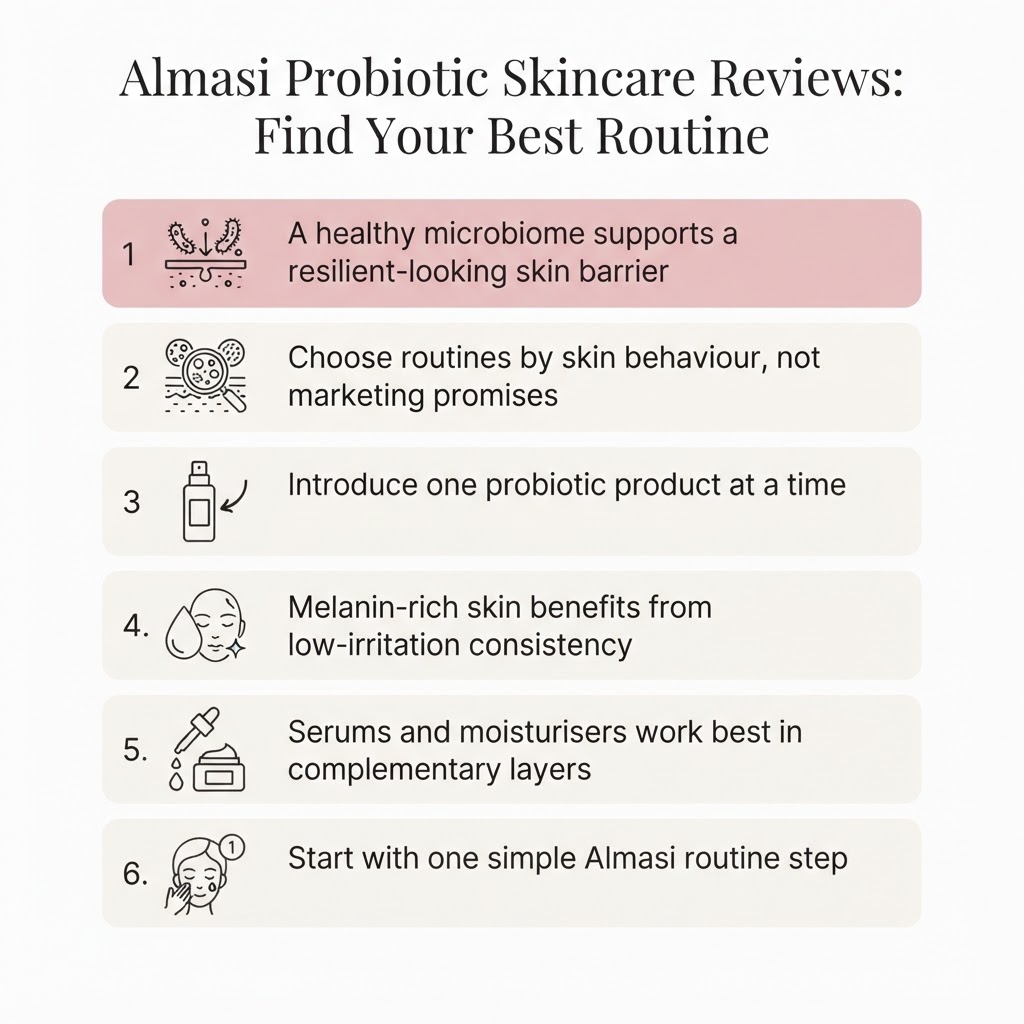
Serums, moisturisers and cleansers: what each layer contributes
Product category matters because different textures perform different jobs. A serum is usually designed to deliver a concentrated blend in a lightweight vehicle. A moisturiser generally combines humectants, emollients and sometimes occlusive ingredients to improve hydration and reduce water loss. A cleanser removes sweat, sunscreen, makeup and environmental residue, but excessive cleansing can leave skin uncomfortable.
Where a probiotic serum belongs
Apply a serum after cleansing and before moisturiser. Use a small amount on slightly damp skin if that feels comfortable, then allow a moment for the product to settle. If you use a treatment serum containing retinoids, exfoliating acids or another potent active, introduce it separately so you can identify the source of any reaction.
Almasi probiotic serum can be a practical choice when you want a light, microbiome-conscious layer that does not make your routine feel complicated. Start every other day if your skin is reactive, then increase frequency only if the experience remains comfortable.
Where a moisturiser belongs
Moisturiser is often the most important finishing layer for dry, dehydrated or barrier-stressed skin. It can also be useful for oily skin when the formula is light enough, because over-cleansing and deliberate drying may encourage a cycle of discomfort and rebound oiliness.
Apply moisturiser after serum, adjusting the amount by area. You may prefer more on the cheeks and less on the forehead or nose. The best texture is the one you can apply consistently without stinging, pilling or feeling uncomfortably heavy.
Why cleansing technique matters
Use lukewarm rather than hot water and avoid scrubbing with textured cloths. Massage cleanser briefly, rinse thoroughly and pat rather than rub. If your skin feels tight immediately after cleansing, consider reducing duration or frequency before adding another active product.
- Morning: cleanse lightly or rinse, apply serum, moisturiser and sunscreen.
- Evening: remove makeup and sunscreen, cleanse, apply serum and moisturiser.
- Reactive days: simplify to gentle cleansing and moisturiser.
- Dry climate: apply moisturiser promptly after cleansing.
How to test probiotic skincare without confusing your skin
The most reliable personal experiment is deliberately boring. Introduce one product at a time, keep the rest of your routine stable and record what happens. This makes it easier to distinguish a product’s effect from changes in weather, menstrual cycle, stress, medication or another new cosmetic.
A simple two-week introduction plan
- Read the ingredient list and check whether you have known sensitivities.
- Patch test on a small area according to the product’s directions.
- Use the product on alternate evenings for the first week.
- If comfortable, use it once daily during the second week.
- Continue sunscreen and avoid adding another active until you understand the product.
Patch testing cannot predict every facial reaction, and irritation may appear after repeated exposure. Stop using a product if you experience significant burning, swelling, hives, blistering or persistent worsening. Seek medical advice for severe or spreading symptoms.
When evaluating almasi probiotic skincare reviews, compare your own observations with the reviewer’s context rather than chasing an identical result. Look for improvements in comfort, softness, hydration and routine consistency before making claims about more complex concerns.
“A gentle skin-care routine and regular use of sunscreen are important parts of managing sensitive skin and reducing irritation.”
— American Academy of Dermatology Association, Skin Care Basics
What results can reasonably look like
Skincare results are cumulative and individual. In the first days, you may notice how a formula feels: less tightness after cleansing, easier layering or a more comfortable finish. Changes in texture and hydration may become clearer over several weeks, while uneven tone and visible lines generally require patience and consistent sun protection.
Probiotic skincare should not be judged by dramatic tingling. Tingling is a sensation, not proof that an ingredient is working. Likewise, an immediate glow may reflect hydration and light reflection rather than a permanent change in skin structure.
- Week one: assess scent, texture, absorption and any stinging.
- Weeks two to four: observe comfort, dryness, oiliness and makeup compatibility.
- Weeks four to eight: consider whether the routine is supporting consistent hydration and calmer-looking texture.
- Beyond eight weeks: review whether your goals, sunscreen use and professional care need adjustment.
Use photographs taken in consistent daylight and keep notes concise. If a product is comfortable but not meeting your main goal, that does not necessarily make it a poor product; it may simply be the wrong tool for that goal.
For background on the relationship between topical ingredients and skin ecology, you can review this peer-reviewed overview of the skin microbiome. The American Academy of Dermatology’s skincare guidance is also useful when building a simple routine.
What to buy first: a simple Almasi starting point
If you are new to probiotic skincare, do not buy an entire shelf at once. Choose the product category that addresses your immediate routine gap. If your skin feels tight after cleansing, begin with moisturising support; if your routine feels heavy and incomplete, a lightweight serum may be the more practical first addition.
A sensible order is cleanser, serum and moisturiser, with sunscreen every morning. You can explore the Almasi probiotic skincare collection and select one product to introduce slowly. The best choice is the one that matches your texture preference, tolerance and daily habits.
In summary, almasi probiotic skincare reviews are most useful when they help you understand formulation, routine placement and realistic expectations. The goal is not to overwhelm your skin with more steps; it is to create a repeatable ritual that supports comfort and resilience across seasons, skin tones and life stages.
Start with one comfortable step
The single simplest first step is to choose one Almasi product—such as an Almasi probiotic serum or moisturiser—and introduce it slowly after cleansing; explore the range at Almasi on the Velobiotics store.
Subscribe to the Almasi Journal for evidence-aware skincare education, routine guidance and new insights from our microbiome-conscious approach.