
Searching for almasi vitamin c serum reviews usually means you want more than a glowing testimonial. You want to know whether a serum fits your skin, how it behaves in a real routine, and whether its formulation makes sense for concerns such as uneven tone, adult acne, sensitivity or visible signs of ageing.
As a medical doctor and founder of Almasi, I believe a useful review should begin with context. Vitamin C is not a one-size-fits-all ingredient, and healthy-looking skin is not created by one active alone. The best routine supports the skin barrier, respects the microbiome and uses a stable, well-tolerated formula consistently.
This guide explains how to assess almasi vitamin c serum reviews with a practical, skin-science lens. We will look at vitamin C forms, probiotic skincare, skin-tone considerations, layering, common mistakes and how to decide whether an Almasi serum belongs in your routine.
What to Look for in Almasi Vitamin C Serum Reviews
Online reviews are useful, but they are personal observations rather than universal results. A reviewer may have different sun exposure, climate, age, pigmentation pattern, cleanser, sunscreen and tolerance for active ingredients. Their experience can help you form questions, but it cannot predict your exact outcome.
Read reviews for patterns, not promises
When comparing almasi vitamin c serum reviews, look for repeated details instead of dramatic claims. Does the formula feel comfortable? Does it layer under moisturiser? Is the packaging practical? Do people describe gradual improvements in radiance or tone rather than overnight transformation?
- Texture: A serum should spread without excessive rubbing or pilling.
- Tolerance: Reviewers should mention whether their skin felt comfortable over several weeks.
- Routine fit: Notice whether it works with moisturiser and sunscreen.
- Packaging: Vitamin C is sensitive to oxygen, light and heat, so thoughtful packaging matters.
- Time frame: Skin changes are generally assessed over weeks, not a single application.
Also consider what the reviewer means by “brightening”. It may refer to increased surface radiance, a more even-looking tone, reduced dullness or the visual effect of hydrated skin. Those are different experiences, and none should be interpreted as a guarantee.
“There is good evidence that topical vitamin C can improve the appearance of photoaged skin, but formulation, concentration and stability are important considerations.”
— Journal of Clinical and Aesthetic Dermatology, 2017
For additional background on antioxidant skincare, you can read our article, Why Vitamin C Serum Is Your Skin's Most Powerful Antioxidant Shield. This guide takes a different approach: it focuses on choosing and using vitamin C within a microbiome-conscious routine.
Vitamin C, the Skin Microbiome and the Barrier
The skin microbiome is the community of microorganisms that naturally live on the skin. It includes bacteria, fungi and other microscopic life that interact with the skin’s surface environment. A balanced microbiome is not the same as a sterile one; the goal is to support a stable ecosystem that can coexist with the skin’s normal protective functions.
The skin barrier is the outer defence system that helps reduce water loss and limits exposure to irritants. Its surface includes corneocytes, which are mature skin cells, surrounded by lipids such as ceramides, cholesterol and fatty acids. When this structure is disrupted, skin may feel tight, sting more easily or become visibly rough and reactive.
Why this matters when choosing a serum
Vitamin C can be a valuable antioxidant, but “more active” does not automatically mean “better”. A very strong or poorly tolerated product may encourage dryness, stinging or over-exfoliation, particularly when combined with acids, retinoids, harsh cleansers or frequent scrubbing.
Probiotic skincare takes a different view of formulation. In Almasi’s Velobiotics™ approach, the aim is to create skincare that works with the skin’s environment rather than treating the surface as an enemy to strip away. This is especially relevant for people whose skin is acne-prone, eczema-prone or easily unsettled.
Probiotic ingredients in topical skincare are not the same as taking a probiotic supplement, and product categories can use the word in different ways. Read the ingredient list and product instructions, and think about the full formula rather than a single marketing term.
- Choose a serum that feels comfortable during repeated use.
- Keep cleansing gentle enough that skin does not feel squeaky or tight.
- Use moisturiser to support comfort and reduce moisture loss.
- Wear broad-spectrum sunscreen because ultraviolet exposure contributes to uneven tone and visible ageing.
- Introduce one new active at a time so you can identify what your skin accepts.
Our guide to The Science of Skin Barrier Repair: How to Rebuild What Modern Life Destroys explores barrier biology in more detail. The key practical point is simple: a vitamin C serum should be part of a supportive routine, not a reason to ignore signs of irritation.
How to Choose a Vitamin C Serum for Your Skin
There are several vitamin C derivatives used in skincare. L-ascorbic acid is the best-known form, while derivatives are designed to improve stability, comfort or formulation flexibility. The right choice depends on the complete product, not just the name of the vitamin C ingredient.
For acne-prone adult skin
Adult acne often appears alongside sensitivity, post-inflammatory marks and a compromised-feeling barrier. A lightweight serum may fit well, but avoid assuming that a tingling sensation means the product is working. Comfort and consistency are more useful measures.
Keep the rest of the routine uncomplicated. A gentle cleanser, vitamin C serum, non-comedogenic moisturiser and sunscreen may be enough in the morning. If you also use acne medication or a retinoid, introduce vitamin C separately and ask a dermatologist or pharmacist about sensible scheduling if irritation develops.
For eczema-prone or reactive skin
Eczema-prone skin can be more vulnerable to fragrance, harsh surfactants and excessive active ingredients. Start with a small patch test and use the serum less frequently if your skin is easily reactive. Do not apply a new product to actively inflamed, cracked or weeping areas without professional guidance.
Look for a routine that prioritises comfort: gentle cleansing, a nourishing moisturiser and sunscreen suited to your skin. If you want a deeper explanation of moisturising choices, visit Probiotic Moisturiser for Eczema-Prone Skin: Barrier Guide.
For hyperpigmentation and melanin-rich skin
Melanin-rich skin can develop noticeable post-inflammatory hyperpigmentation after spots, irritation or minor injury. This makes prevention of unnecessary irritation particularly important. A serum that causes persistent burning may work against your broader goal by provoking inflammation.
Sunscreen remains essential, including for people who do not burn easily. Tinted formulas containing iron oxides may be worth discussing with a dermatologist because visible light can contribute to pigmentation in some people, especially those prone to dark marks.
For hyperpigmentation, assess progress in consistent lighting and over a realistic time frame. Compare photographs taken at similar angles rather than relying on day-to-day mirror impressions, which can be affected by hydration, lighting and temporary redness.
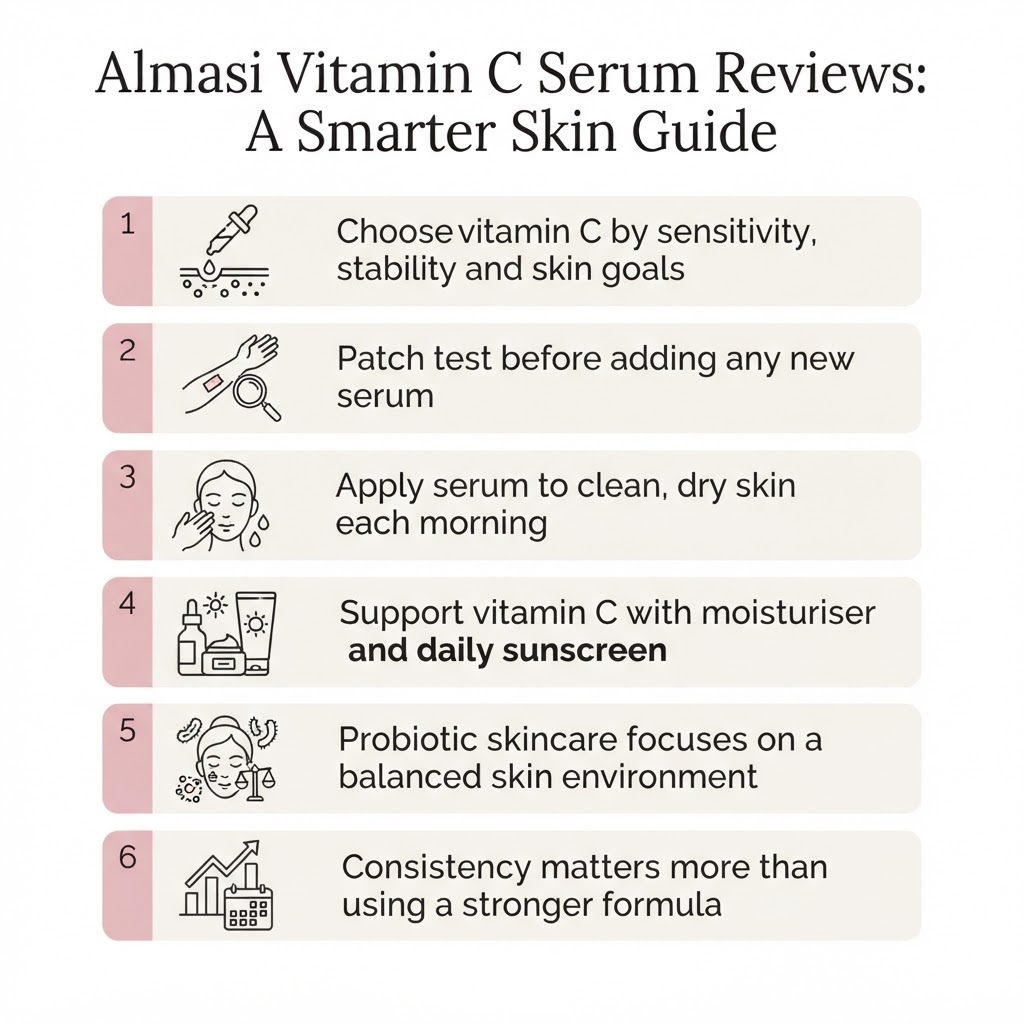
How to Use Almasi Vitamin C Serum in a Daily Routine
A simple routine is easier to follow and easier to troubleshoot. Apply products from the thinnest texture to the richest, allowing each layer to settle briefly. You do not need a complicated sequence to support healthy-looking skin.
Morning routine
- Cleanse gently, or rinse with lukewarm water if your skin does not need a morning cleanse.
- Apply a small amount of vitamin C serum to clean, dry or slightly damp skin, following the product directions.
- Use moisturiser if your skin feels dry or tight.
- Finish with broad-spectrum sunscreen and reapply as directed, particularly when outdoors.
When people discuss almasi vitamin c serum reviews, application technique often explains some of the variation. Using too much product, applying it immediately after a strong exfoliant or skipping sunscreen can make a routine feel less successful than expected.
Evening routine
You do not need to use vitamin C twice daily unless the product directions specifically support it and your skin tolerates it. Evening is often a good time to focus on cleansing, moisturising and any separate dermatologist-recommended active.
If you use a retinoid, exfoliating acid, benzoyl peroxide or another active ingredient, avoid adding everything at once. Alternating products may be more comfortable, although individual routines differ.
How to introduce it
- Patch test on a small area according to the product instructions.
- Use the serum every second or third morning initially if you are sensitive.
- Increase gradually only if your skin remains comfortable.
- Stop and reassess if you develop persistent burning, swelling, hives or marked irritation.
- Store the product as directed, away from excessive heat and direct sunlight.
“A broad-spectrum, water-resistant sunscreen with an SPF of 30 or higher is recommended for all patients.”
— American Academy of Dermatology, 2024
The peer-reviewed review of topical vitamin C describes why stability and delivery systems influence how vitamin C performs in skincare. In practical terms, a product that remains stable and comfortable is more likely to be used consistently.
What Almasi Vitamin C Serum Reviews Can and Cannot Tell You
A thoughtful review can answer practical questions: Is the texture elegant? Does it sit comfortably under sunscreen? Is the bottle easy to use? Does the reviewer describe a gradual improvement in radiance or tone after consistent use?
It cannot establish that every person will see the same outcome. Skin biology varies, and visible tone is influenced by ultraviolet exposure, hormones, inflammation, age, medications, sleep, climate and genetics.
Signs a review is useful
- It identifies the reviewer’s skin type and main concern.
- It explains how often the product was used.
- It mentions the rest of the routine.
- It distinguishes comfort from visible results.
- It avoids absolute claims and instant-result language.
Questions to ask before buying
- Is the serum appropriate for my sensitivity level?
- Can I use it with my current cleanser, moisturiser and sunscreen?
- Am I already using several potentially irritating actives?
- Will I use it consistently enough to assess it fairly?
- Is the packaging suitable for a light- and oxygen-sensitive ingredient?
When evaluating almasi vitamin c serum reviews, remember that an elegant texture is valuable because it supports adherence, but it is not the same as a clinical outcome. Conversely, a gradual result may be meaningful even if it is not dramatic in the first week.
Building a Complete Routine Around Vitamin C
Vitamin C is most useful when it fits into a balanced routine. For many people, the foundation is gentle cleansing, targeted serum, moisturiser and sunscreen. You can adjust the texture and richness according to your climate, skin type and seasonal needs.
A simple routine by skin concern
- Dry or mature skin: Use a hydrating cleanser, vitamin C serum, nourishing moisturiser and sunscreen.
- Combination skin: Use a lightweight serum and apply more moisturiser only where needed.
- Acne-prone skin: Keep layers light, avoid unnecessary fragrance and introduce actives gradually.
- Reactive skin: Patch test, use fewer actives and prioritise barrier comfort.
- Melanin-rich skin with dark marks: Pair gentle brightening care with diligent sunscreen and irritation prevention.
An Almasi routine can include an Almasi probiotic serum alongside a moisturiser selected for your skin’s comfort needs. The objective is not to overwhelm the skin with products, but to create a routine you can repeat.
Ingredients should also be considered in combination. A vitamin C serum may sit comfortably beside hydrating ingredients, antioxidants and moisturisers, while stronger exfoliants and retinoids may require more careful spacing. If you are pregnant, breastfeeding, managing a dermatological condition or using prescription products, seek personalised medical advice.
Research on the microbiome is developing, and topical probiotic skincare is not a substitute for diagnosis or medical treatment. However, a microbiome-conscious approach encourages a useful discipline: cleanse without unnecessary aggression, protect the barrier and choose products that your skin can tolerate.
For consumers comparing almasi vitamin c serum reviews, this is the most important takeaway. A good serum should not be judged only by how active it feels on application. Judge it by whether it fits your skin, your routine and your ability to use it consistently.
Your Simplest First Step: Start With One Almasi Serum
If you want to try vitamin C, the simplest first step is to choose one Almasi serum, patch test it and apply it on alternate mornings before moisturiser and sunscreen. Explore the Almasi collection and select the product whose texture and routine fit feel most realistic for you.
Subscribe to the Almasi Journal for practical guidance on probiotic skincare, skin science and routines for every skin tone.